
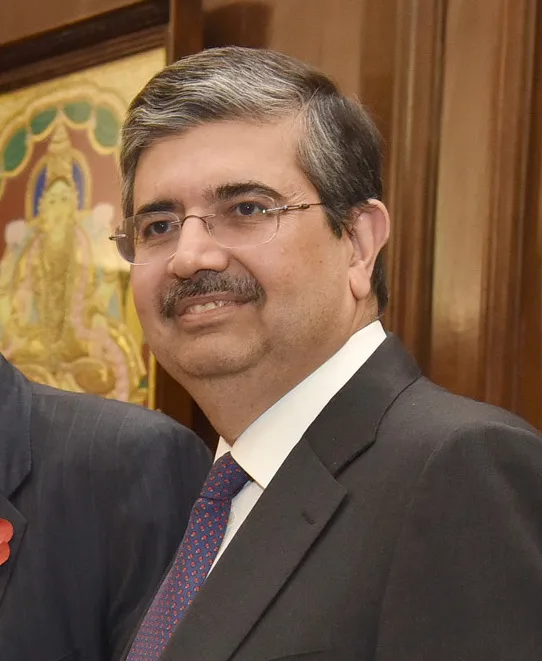
It started as a small finance venture in the 1980s. Decades later it is Kotak Mahindra Bank, among India's leading private lenders — and one of the very few banks of national scale anywhere that a single founder actually built rather than inherited or bought.
Uday Kotak's reputation is for saying no. Conservative risk management, disciplined growth, asset quality ahead of expansion. It looked unambitious during every boom and then looked extremely clever during every credit cycle that took out the lenders who had been braver.
In banking, survival is the strategy. Kotak's obsession with risk is why he was still standing after every cycle.
From lending the group spread into banking, broking, asset management and insurance, until its results were read as a proxy for Indian financial services generally. Along the way it made him one of the country's wealthiest self-made bankers.
Then regulation tightened around how much of a bank a promoter may own, and he stepped back from running it day to day. The test now is the one every personality-led institution eventually faces: does the caution survive without the person whose instinct it was?
Kotak grew up in a large joint family in Mumbai that ran a cotton trading business, and took an MBA at the Jamnalal Bajaj Institute of Management Studies. Instead of joining the family firm, he started a bill-discounting business in 1985 with borrowed capital and an early investment from Anand Mahindra, whose family name is still in the bank's title. In 2003 Kotak Mahindra Finance became the first non-banking finance company in India to receive a banking licence.
The group's breadth came from partnerships and buyouts. It ran joint ventures with Goldman Sachs in investment banking and broking and with Old Mutual in life insurance, later buying out both partners. In 2014 it agreed to acquire ING Vysya Bank in a share swap, then one of the largest bank mergers in the country.
In 2017 he chaired a SEBI committee on corporate governance whose recommendations on board independence and disclosure reshaped the rules for listed companies. He stepped down as managing director and chief executive in September 2023, before his term was due to end, and stayed on the board as a non-executive director, with Ashok Vaswani taking over in January 2024. Later that year the RBI barred the bank from onboarding customers online over technology lapses, a restriction lifted in 2025.