
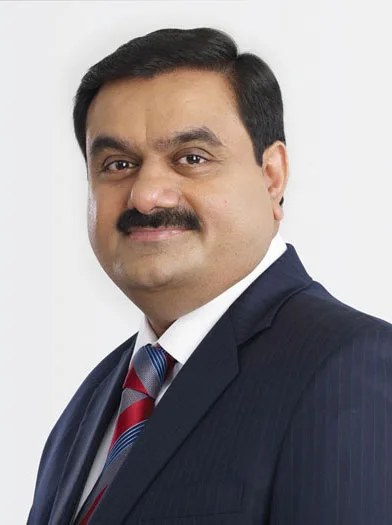
If Mukesh Ambani built an empire aimed at the Indian consumer, Gautam Adani built the opposite kind of business — the physical infrastructure the rest of the economy runs on. Ports and airports, power plants and transmission lines, and one of the most ambitious renewable-energy programmes in the world: the Adani Group operates the arteries through which much of India's growth flows.
Adani's rise is one of the most dramatic in modern business — a first-generation entrepreneur who built a sprawling conglomerate in capital-intensive, heavily regulated sectors where execution matters more than brand. It is also a story that has been tested, publicly and severely, by a short-seller's report that wiped out a large share of the group's value and forced a reckoning over debt and governance.
From commodities trader to infrastructure baron
Adani began not in construction but in trading — buying and selling commodities — before recognising that the real opportunity lay in owning the infrastructure that commodities move through. His breakthrough was the port at Mundra, on India's western coast, which he developed into the country's largest commercial port and the template for everything that followed.
The strategy was consistent and aggressive: identify a critical piece of national infrastructure, build or acquire it at scale, and finance the expansion heavily. From ports, Adani moved into power generation and transmission, then into airports — becoming one of India's largest airport operators — and into cement, data centres and green energy. The thesis underneath it all was a bet on India itself: that a country building out its physical backbone would richly reward whoever owned that backbone.
What is striking about the expansion is how deliberately the pieces fit together. A port needs power; power needs transmission; transmission and data centres need land and logistics; airports and cities need cement. By owning links across the chain, Adani built a group in which each business could feed the next — a form of vertical integration applied not to a single product but to the physical foundations of an entire economy. It made the group formidable, and also tightly interconnected, in ways that would matter greatly when it came under attack.
| Segment | Role | Position |
|---|---|---|
| Ports & Logistics | Cargo gateways and supply-chain infrastructure | India's largest private port operator |
| Energy & Power | Generation, transmission and distribution | A major national power player |
| Airports | Operating and modernising major airports | Among India's largest airport operators |
| Renewables | Solar and wind generation, green hydrogen | One of the world's largest solar ambitions |
| Cement & Materials | Building materials at scale | A top-tier Indian cement producer |
The playbook: move first, finance heavily
What distinguishes Adani from most industrialists is his tolerance for capital intensity and leverage. Infrastructure is a slow, expensive business; returns arrive over decades, and projects demand enormous upfront investment. Adani's willingness to move first and borrow heavily let him build faster than rivals — but it also concentrated risk, tying the group's fortunes to its ability to keep servicing a large and growing pile of debt.
For years, that trade paid off spectacularly. The group's market value soared, and Adani's personal wealth rose at one of the fastest rates the world had ever recorded, briefly placing him among the very richest people on the planet.
Infrastructure is a bet on a country's future. Adani placed that bet on India at industrial scale.
The Hindenburg shock
In early 2023, that trajectory met its sternest test. Hindenburg Research, an American short-seller, published a report alleging accounting irregularities and governance concerns across the Adani Group and questioning its debt levels and share-price valuations. The group forcefully denied the allegations, calling the report baseless and an attack on India itself.
The market reaction was brutal. A vast amount of the group's combined market value evaporated in a matter of weeks, and Adani's personal fortune contracted sharply. Beyond the immediate losses, the episode changed how investors, lenders and regulators scrutinised the group — its disclosures, its related-party structure, and above all its leverage. The group moved to steady itself: paring debt, reassuring lenders, and securing fresh investment to demonstrate confidence.
| Dimension | Pre-report narrative | Post-report reality |
|---|---|---|
| Market value | Soaring, near record highs | Sharp fall, partial recovery over time |
| Investor view | Growth story | Intense scrutiny of debt and governance |
| Group priority | Aggressive expansion | Deleveraging and rebuilding trust |
The debt question
At the centre of every debate about the Adani Group is a single number that is really a question: how much debt is too much? Building ports, power plants and airports requires borrowing on an enormous scale, and for years Adani argued that his debt was well-matched to long-life, cash-generating assets — that a port or a transmission line throws off predictable revenue for decades, comfortably servicing the loans that built it.
Critics countered that the group's leverage left little room for error, and that a shock — a rise in interest rates, a downturn, a loss of market confidence — could turn a manageable debt load into a dangerous one. The 2023 sell-off gave that argument sudden force, and the group responded by prepaying loans, reducing pledged shares, and publishing detailed rebuttals of the concerns. The episode did not settle the debate so much as institutionalise it: leverage is now the lens through which every Adani announcement is read.
- Long-life assets (ports, power, transmission) generate steady, contracted cash flows.
- But heavy borrowing concentrates risk if confidence or conditions turn.
- Post-2023, the group prioritised deleveraging and clearer disclosure.
- Every new project is now judged against the group's debt profile.
What the crisis revealed
Beyond the numbers, the 2023 episode revealed something about the nature of empires built at speed. The very qualities that made Adani's rise possible — audacity, leverage, a willingness to enter regulated sectors and dominate them — were also the qualities that made the group vulnerable to a crisis of confidence. Scale had been a strength; under attack, it briefly became a liability, because so much value was concentrated in so few, closely linked entities.
It also revealed the group's resilience. Rather than retreat, Adani steadied the business, secured fresh investment from a marquee global investor as a vote of confidence, and pressed ahead with expansion. Within a period that many had predicted would be terminal, the group had stabilised and resumed growth — a reminder that infrastructure, once built and operating, is a stubbornly durable form of value.
The green pivot
Since the crisis, Adani has leaned hard into a green-energy narrative, pledging enormous investment in solar manufacturing and renewable capacity as part of India's energy transition. It is both a genuine strategic bet — India needs vast clean-power capacity — and a repositioning, aligning the group with a story of national development rather than leverage.
The ambition is characteristically large: to build one of the world's biggest renewable-energy businesses, integrated from solar-panel manufacturing through to generation, at the same industrial scale that defined the group's earlier expansion. If it succeeds, it would recast Adani from a builder of traditional infrastructure into a central player in the clean-energy economy — and give the group a growth story untethered from the controversies of the past.
The tension at the heart of the Adani empire remains the same one that has always defined it: the balance between ambition and discipline, between the will to build at unmatched scale and the arithmetic of the debt that makes it possible. That tension is the perennial condition of every infrastructure empire — and Adani's is simply the largest and most scrutinised example of it.
- Own critical, hard-to-replicate infrastructure.
- Move first and finance the build-out heavily.
- Integrate across the value chain — from port to power to materials.
- Align with national priorities, now including green energy.
- Manage the ever-present risk of leverage.
What comes next
Adani's trajectory now depends on execution and discipline in equal measure: delivering the green-energy build-out he has promised, while keeping the group's debt within limits that markets and lenders will accept. If he succeeds, he will have turned a first-generation trading business into one of the defining industrial institutions of modern India. The rankings and net-worth figures will keep swinging with the market; the infrastructure, if it is built well, will outlast them all.
Perhaps the most useful way to understand Adani is as a wager on time. Infrastructure rewards those who can wait — for a port to fill with traffic, for a power plant to reach capacity, for a country to grow into the capacity built ahead of it. Adani built ahead of the demand, and financed it on the assumption that India's growth would arrive to meet it. So far, for the most part, it has. The open question is whether he can keep that bet balanced through the next cycle, when the scrutiny is sharper and the margin for error thinner than it has ever been.