
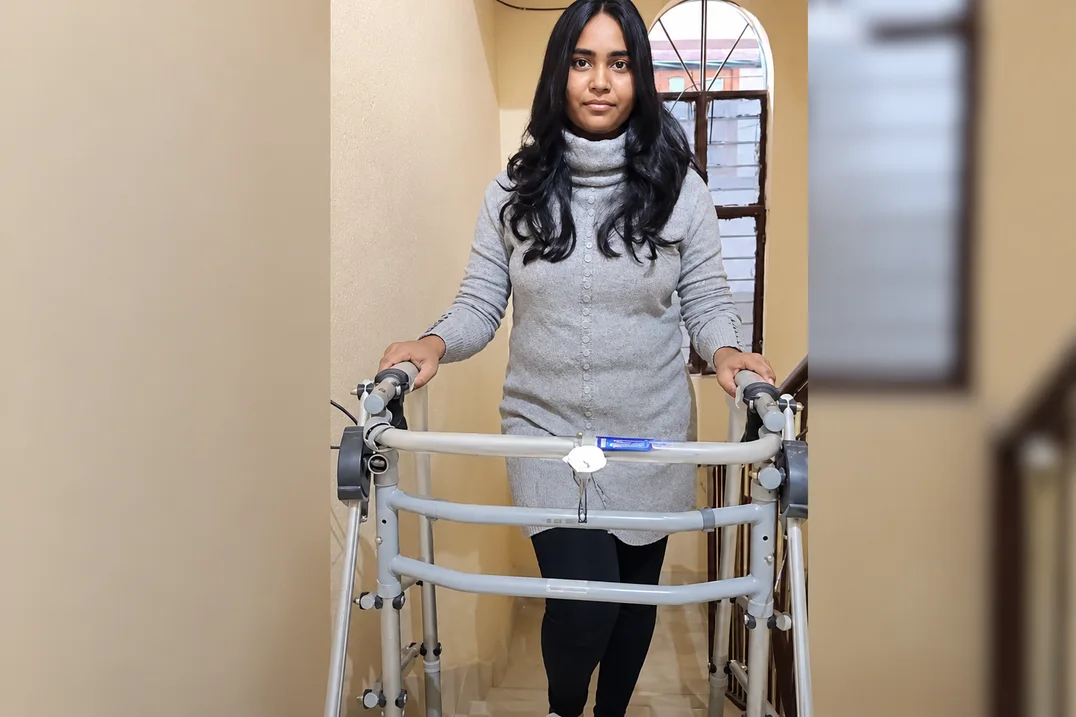
Shalini Kumari's idea began with a small loss of freedom. After an accident, her grandfather used a walker on flat surfaces but struggled with stairs. He could no longer reach the terrace garden he enjoyed. Shalini, then a school student in Patna, Bihar, asked why a familiar mobility aid could not adjust to the height of a step.
Designing a walker for uneven surfaces
Her proposal used adjustable legs to provide additional support while climbing stairs. The October 2026 feature also describes ideas for a folding seat, lighting and an alert mechanism. Such features need careful design: a user must be able to shift weight safely, and the device must remain stable as the ground changes height. Shalini's initial sketch therefore needed engineering work before it could become a functional prototype.
She submitted the concept to the National Innovation Foundation's IGNITE programme, where designers and engineers helped develop it. The magazine reports that the technology was later transferred to Vissco Rehabilitation Aids for commercial development. That transfer is a step toward possible use, though the profile does not establish current retail availability or clinical suitability for every user.
Recognition for a personal solution
In December 2022, Shalini won first prize in the Grassroots Innovation Competition at the third ASEAN-India Grassroots Innovation Forum in Cambodia, according to the October issue. The recognition gave a personal idea a much larger audience. Still, the origin remains the most revealing part of the story: she was thinking about her grandfather's ability to return to his garden, not about a prize.
Her experience shows how close observation can expose a gap in an everyday product. A useful innovation can begin in a home, provided the idea is then tested and developed with people who understand both design and users' needs. Read the October feature in the full issue.