
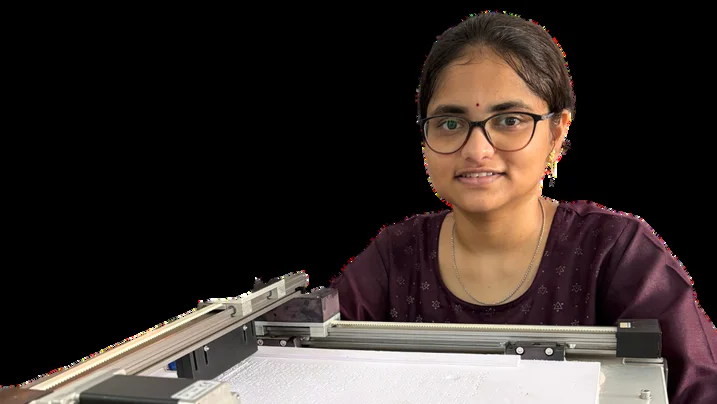
A visit to a school for visually impaired students near her college changed Lingampalli Himaja's engineering project. She saw students use a slate and stylus to make Braille documents, a process that requires careful pressure and an understanding of reversed dot patterns. Himaja began asking whether a device could make independent document creation easier.
From buttons to voice commands
Himaja studies Electrical and Electronics Engineering at Shri Vishnu Engineering College for Women in Bhimavaram, Andhra Pradesh. Her first design let a user select Braille dots through buttons. A student's suggestion changed the direction: speaking would be easier than repeatedly pressing keys. That feedback led to RUDHRA, a prototype designed to convert spoken instructions into embossed Braille characters.
According to the October issue, the system uses speech recognition to turn a user's words into text, processes that text into Braille patterns and prints raised dots on paper. Voice commands are intended to support document creation and editing. Turning that sequence into a reliable device required adjustments to both software and the mechanical embossing system, along with more feedback from intended users.
Recognition and the work still ahead
The magazine reports that RUDHRA won the India edition of the James Dyson Award in September 2026 and was selected among the global top 20 projects in October. Recognition has helped bring attention to the prototype, but it is not the same as widespread availability. Himaja wants to refine the device so it becomes more compact, dependable and affordable for schools and individuals; automatic paper feeding is among the features she hopes to add.
RUDHRA began with an observed problem and a conversation with students. That origin is central to the project: accessibility tools become useful when people who may rely on them shape the design. Read the October magazine feature for the original profile.