
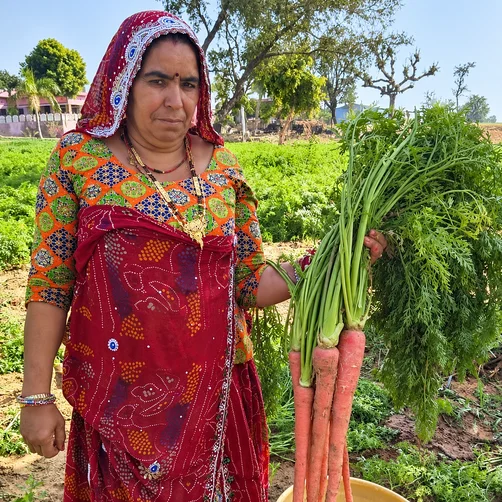
A few carrots from a nearby farmer caught Santosh Pachar's attention. Their colour, sweetness and relatively straight roots made her wonder whether those qualities could be repeated. In Sikar district, Rajasthan, she began preserving selected carrots for seed rather than using the entire crop for consumption. Her experiment would continue across several growing seasons.
Improvement through patient selection
Over four to five years, Santosh selected plants for length, softness, colour and taste. The result became known as the Laxmangarh Selection carrot. The October issue describes long roots, a vermilion colour and sweetness among its distinguishing traits. It also says the crop can grow under relatively warm conditions and typically matures in about two and a half to three months, citing the National Innovation Foundation.
Her work was grounded in the familiar decisions farmers make every season: which plants perform well, which seeds are worth keeping and how a crop responds to local conditions. By applying that judgement consistently over several years, she turned routine observation into a deliberate breeding effort. The profile also notes her attention to seed preparation and cultivation practices.
Recognition and sharing seeds
The National Innovation Foundation recognised Santosh through its seventh National Biennial Grassroots Innovation Awards in 2013, according to the magazine. She has also shared seeds and farming knowledge with growers beyond her village. That exchange matters because a variety's value depends on whether other farmers can grow it successfully in their own conditions.
Selection is a slow process because one promising harvest does not show whether a trait will persist. Santosh's repeated work across seasons gave her more chances to observe the crop and retain plants with preferred characteristics. The Laxmangarh Selection story therefore highlights persistence as much as discovery: the initial carrots suggested a possibility, while years of seed saving developed it.
Santosh's story shows that agricultural innovation can come from farmers who know a crop closely and keep careful track of useful differences. Formal evaluation remains valuable, but the first step may simply be a farmer deciding to save the seed of an exceptional plant. Read the October magazine feature.