
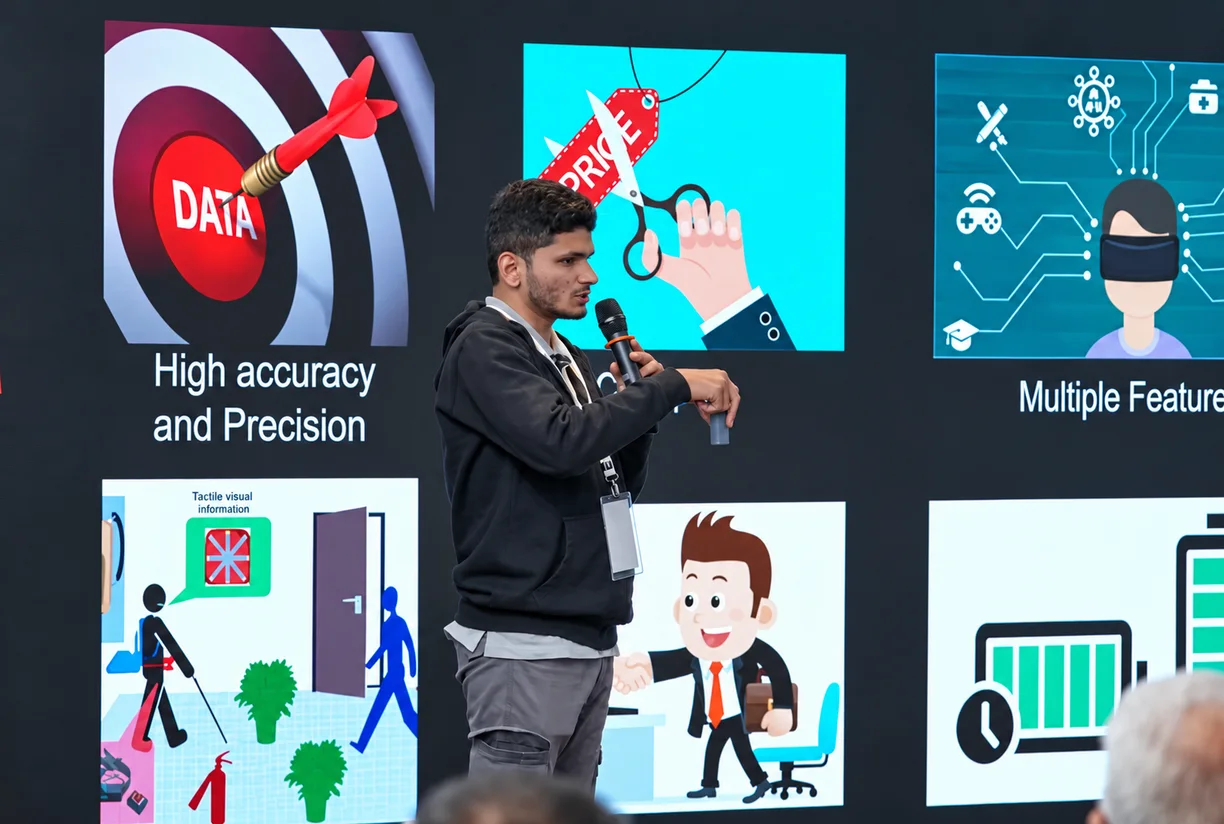
T. Ravi Kiran was interested in robotics and electronic devices before social innovation workshops encouraged him to begin with a different question: whose daily life could a device improve? The young innovator from Telangana focused on barriers faced by people with visual impairments, from recognising an obstacle to reading a signboard. That shift in purpose led to Blind Eye.
How the Blind Eye prototype is designed to help
Blind Eye is a wearable assistive-device prototype intended to relay information about the user's surroundings through audio. The October issue describes obstacle detection, object identification, facial recognition and multilingual reading among its functions. Sensors and recognition software identify nearby objects, while text-to-speech is designed to read printed information aloud. These functions are goals of a developing device, not a guarantee of performance in every environment.
The project was developed through a youth innovation initiative supported by UNICEF's YuWaah programme in Telangana. Mentoring and technical guidance helped Ravi improve the prototype. The issue says Blind Eye was recognised among the global winners of Generation Unlimited's imaGen Ventures Youth Challenge in 2023, bringing wider attention to the idea.
The challenge beyond a working prototype
For assistive technology, a demonstration is only one step. Cost, reliability, usability and availability determine whether a device can make a meaningful difference to the people it was designed for. Ravi has expressed interest in working with government organisations, NGOs and other partners to make future versions accessible to underserved communities.
The proposed mix of obstacle sensing and printed-text reading addresses different moments in a user's day. Identifying an object nearby, hearing a sign and getting a warning about a barrier are separate tasks, each demanding accurate feedback. This is why user testing and clear limits matter as much as adding new features to an assistive device.
The Blind Eye story connects engineering with empathy. It began when Ravi placed the everyday experiences of users ahead of a technical demonstration. Whether the prototype reaches scale will depend on continued testing and partnerships, but its intended purpose is clear: supporting independence and dignity. See the October issue for the magazine profile.