
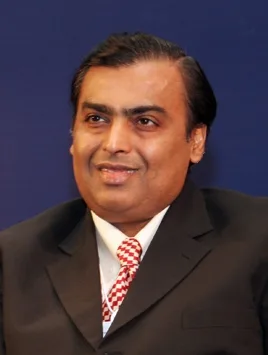
Few individuals sit as close to the centre of a national economy as Mukesh Ambani sits to India's. As chairman and largest shareholder of Reliance Industries — the country's most valuable company — he presides over an empire that touches the daily life of nearly every Indian: the fuel in their vehicles, the data on their phones, the groceries in their kitchens, and increasingly the digital services that stitch it all together.
What makes Ambani's story remarkable is not simply its scale, but its reinvention. The Reliance he inherited was a petrochemicals and refining giant. The Reliance he built is something else entirely — a consumer-technology conglomerate that used cheap capital and ruthless scale to enter markets, subsidise adoption, and turn itself into a platform others must plug into rather than compete against.
From textiles to a trillion-rupee empire
The Reliance story began with Mukesh's father, Dhirubhai Ambani, who founded the company as a textiles and polyester venture and grew it through a legendary appetite for backward integration — moving from fabric to fibre to the petrochemicals that made the fibre. By the time Mukesh took the reins, Reliance was already one of India's largest private enterprises, anchored by the vast Jamnagar refinery complex, among the biggest in the world.
Mukesh's instinct was to keep integrating, but in a new direction: toward the consumer. Where his father had built the supply chain of Indian industry, the son set out to own the demand side — the hundreds of millions of Indians who were, in the 2010s, about to come online for the first time. That pivot, from an oil-to-chemicals business into telecom, retail and digital services, is the defining arc of his career.
| Business | What it does | Why it matters |
|---|---|---|
| Oil-to-Chemicals | Refining and petrochemicals, anchored by the Jamnagar complex | The cash engine that funded everything else |
| Jio (Telecom & Digital) | Mobile network, broadband, and a suite of digital apps | Brought hundreds of millions of Indians online |
| Reliance Retail | India's largest retailer across grocery, fashion and electronics | The consumer distribution backbone |
| New Energy | Solar, batteries and green hydrogen (in build-out) | The next multi-decade bet |
The Jio gamble that rewired India
The single most consequential decision of Ambani's career was the launch of Jio in 2016. Reliance had spent years and an enormous sum building a nationwide 4G network from scratch. Then it did something almost nobody expected: it gave the service away, offering months of free voice and data before settling on prices that were a fraction of what rivals charged.
The effect was seismic. A price war collapsed the old telecom order almost overnight; weaker operators merged or exited, and the survivors were forced to slash prices to stay alive. For consumers, the result was transformational — India went from one of the more expensive places to buy mobile data to one of the cheapest, and hundreds of millions of people came online for the first time, many of them streaming video and using digital payments within months.
Jio was never really about telecom margins. It was about owning the pipe into the Indian consumer's phone, and then selling everything that could flow through it. Having built the largest mobile network in the country, Reliance turned to what came next: commerce, content and financial services delivered over that same connection.
The social consequences were as large as the commercial ones. Cheap data changed how ordinary Indians banked, learned, entertained themselves and ran small businesses. A street vendor accepting digital payments, a student watching lectures on a phone, a farmer checking crop prices — these everyday scenes became possible at national scale in a span of a few years, and Jio was the current running beneath them.
Jio did not enter India's telecom market. It rewrote the economics of the entire industry overnight.
Why rivals could not respond
Competitors understood exactly what Jio was doing; what they could not do was match it. Reliance had two advantages that were almost impossible to counter. The first was capital: the oil-to-chemicals business threw off enough cash to absorb years of losses in telecom without flinching. The second was patience — the willingness to lose money for as long as it took to win the market, because the prize was not telecom profit but a permanent position in every consumer's digital life.
That combination — a deep balance sheet and a long time horizon — is the essence of the Ambani method. It is why analysts describe Reliance less as a company entering markets and more as a force reshaping them. When Reliance decides a sector is strategic, the question for incumbents is rarely whether they can out-compete it on product, but whether they can survive its willingness to spend.
The retail and digital land grab
With the pipe in place, Ambani moved aggressively into retail and digital commerce. Reliance Retail grew into India's largest retailer by revenue and store count, spanning grocery, fashion, consumer electronics and a fast-growing e-commerce operation designed to connect the country's millions of small neighbourhood shops to a modern supply chain.
To fund and validate this ambition, Ambani did something Reliance had rarely done before: he courted outside capital at scale. In a remarkable stretch, a roster of marquee global technology and private-equity investors poured billions into Jio Platforms and Reliance Retail, giving the digital and consumer businesses independent heft — and giving Ambani a war chest to keep expanding.
A timeline of the empire
| Year | Milestone |
|---|---|
| 1966 | Dhirubhai Ambani founds Reliance as a textiles venture |
| 2002 | Mukesh Ambani steps up to lead Reliance Industries |
| 2016 | Jio launches, triggering India's telecom price war |
| 2020 | Global investors pour billions into Jio Platforms and Reliance Retail |
| 2021+ | Reliance commits tens of billions to a green-energy transition |
| 2020s | Operational leadership of telecom, retail and energy passed to the next generation |
Succession and the next bet: green energy
As Ambani has entered a new phase, two themes dominate. The first is succession. He has begun handing operational control of the group's major arms — telecom, retail and new energy — to his three children, in one of the most closely watched dynastic transitions in global business. The structure is deliberate: each heir is being given a distinct empire to run and prove themselves against.
The second theme is energy — but not the fossil kind that built the company. Ambani has committed a vast sum to a clean-energy transition spanning solar manufacturing, batteries and green hydrogen, aiming to build an integrated renewable-energy business at the same industrial scale that defined Reliance's refining era. Whether Reliance can repeat the Jio playbook — enter late, spend enormously, and dominate through scale — in a field as capital-intensive and technically demanding as clean energy is one of the most consequential questions in Indian business.
- Enter a fragmented market late, with overwhelming capital.
- Subsidise adoption aggressively to win scale fast.
- Build a platform others must plug into rather than compete against.
- Integrate vertically so each business feeds the next.
- Hold for the long term, and let scale compound.
More than a company
It is difficult to overstate how central Reliance has become to India's economic story. It is consistently one of the country's largest employers, a dominant weight in the benchmark stock indices that anchor millions of Indians' pensions and savings, and one of the biggest contributors to the national exchequer. When Reliance reports earnings, it is not merely a corporate event; it is a reading on the health of a large slice of the Indian economy.
That centrality cuts both ways. It gives Ambani extraordinary reach and influence, but it also means his decisions carry public consequences well beyond his shareholders. A bet that pays off — as Jio did — can lift the whole economy; a misstep at Reliance's scale would be felt nationally. Few private individuals anywhere operate with that kind of systemic weight, and fewer still have used it to reshape as many industries in a single career.
What comes next
For all the talk of net worth and rankings — figures that rise and fall with the market and vary by source — the more interesting measure of Ambani is structural. He has repeatedly reshaped not just his own company but the industries it entered, from telecom to retail. The green-energy bet will test whether that pattern holds one more time, in an arena where the competition is global and the physics unforgiving.
If it works, Reliance will have reinvented itself for a third time in two generations — from textiles, to petrochemicals, to digital, to energy. If it stumbles, it will be a reminder that even the most formidable playbook meets its limits. Either way, the outcome will shape the Indian economy for a decade, because in India, what Reliance does is rarely a private matter.
There is a broader lesson in Ambani's method for anyone studying how modern conglomerates are built. He does not chase the market that exists today; he builds for the one that will exist tomorrow, and he is willing to spend years and enormous sums getting there before the returns arrive. It is a strategy few companies have the balance sheet or the nerve to attempt. Reliance has both — and that, more than any single business, is the real moat around Mukesh Ambani's empire.