
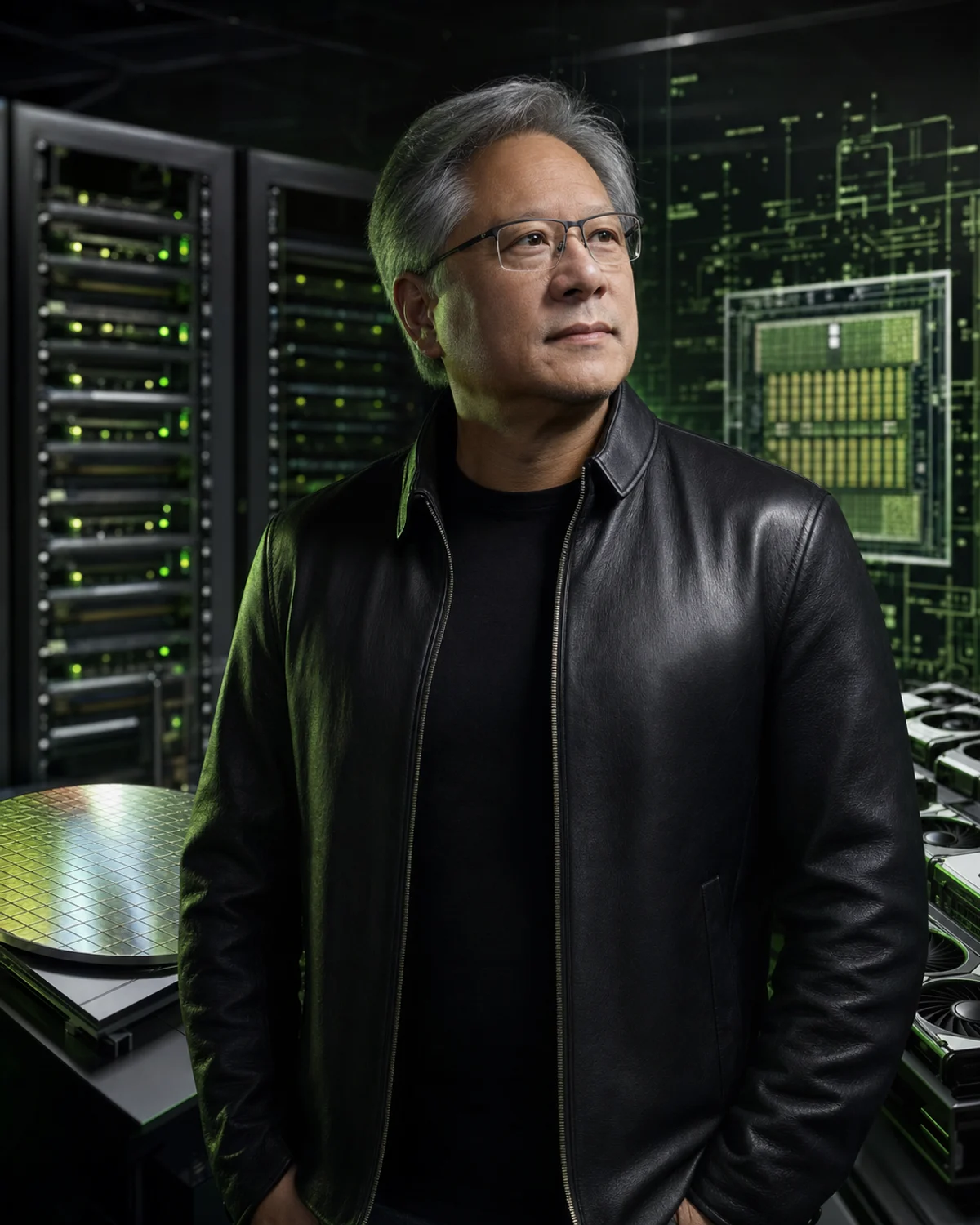
For most of Nvidia's life, Jensen Huang ran a company that mattered enormously to people who built video games and very little to anyone else. That changed with startling speed. As artificial intelligence moved from research curiosity to the defining technology of the decade, the specialised chips Huang had spent thirty years refining turned out to be the one component the entire industry could not do without. Almost overnight, the engineer who started Nvidia at a diner became the steward of the hardware on which modern AI is built.
His story is not one of a sudden lucky break. It is the opposite: a decades-long, patient bet on a form of computing the rest of the industry dismissed, sustained through near-bankruptcy, boom-and-bust cycles and repeated scepticism. Understanding how Nvidia came to sit at the centre of the AI economy means understanding the unusual founder who refused to let go of the idea.
| Detail | Information |
|---|---|
| Born | 17 February 1963, Taipei, Taiwan |
| Education | BSEE, Oregon State University (1984); MSEE, Stanford University (1992) |
| Before Nvidia | Advanced Micro Devices (1984–85); LSI Logic (1985–93) |
| Company | Nvidia — co-founder, president and CEO since 1993 |
| Co-founders | Chris Malachowsky and Curtis Priem |
| FY2025 revenue | $130.5 billion (up 114% year-on-year)* |
| Known for | GPUs, the CUDA platform, and the AI accelerated-computing era |
*Figures from Nvidia's fiscal-2025 results; company financials change every quarter and should be checked against the latest filing.
From Taiwan to a diner in San Jose
Jensen Huang was born in Taipei in 1963 and spent his early childhood in Taiwan and Thailand before his family sent him to the United States. The arrangement was, by his own later account, far from smooth: at around the age of ten he was enrolled at the Oneida Baptist Institute in rural Kentucky, a school he and his brother attended before the family reunited in Oregon. He finished high school there, graduating young.
He went on to study electrical engineering at Oregon State University, earning his bachelor's degree in 1984, and later completed a master's degree in electrical engineering at Stanford in 1992 — studying in the evenings and at weekends while already working in the semiconductor industry. That combination of formal engineering training and shop-floor experience would shape how he built and ran Nvidia.
Learning the industry: AMD and LSI Logic
Before he was a founder, Huang was a chip designer and an operator. He began his career at Advanced Micro Devices, the semiconductor company where he worked as a microchip designer, before moving to LSI Logic, where he spent most of the years between 1985 and 1993 in engineering and management roles. It was there that he learned not just how chips are made but how the business of selling them to other companies works.
That vantage point mattered. By the early 1990s, Huang had seen where computing was heading and where the industry's incumbents were not looking. Graphics — the job of drawing images on a screen — was becoming more demanding as personal computers moved toward richer, three-dimensional visuals. The general-purpose processors of the day were poorly suited to the task. Huang and two colleagues concluded there was room for a company built specifically to accelerate it.
The bet on accelerated computing
In 1993, Huang co-founded Nvidia with Chris Malachowsky and Curtis Priem. The founding meeting, according to the company's own retelling, took place at a Denny's in San Jose; the trio started with roughly $40,000 in capital and a conviction that a new category of processor was coming. Huang became chief executive and has never relinquished the role.
The early years were difficult. Nvidia's first products struggled, the company came close to running out of money more than once, and the market for graphics chips was crowded with rivals that have since disappeared. What set Nvidia apart was a single, stubborn idea: that specialised parallel processors — chips designed to do many calculations at the same time rather than one after another — would eventually matter far beyond gaming. In 1999 the company popularised the term 'GPU', or graphics processing unit, with the launch of the GeForce 256, framing the chip not as a peripheral but as a distinct class of processor.
Nvidia did not get lucky when AI arrived. It spent two decades building the shovel before anyone knew there was gold.
Building Nvidia: from near-death to the AI era
The decision that turned Nvidia from a successful chip company into an essential one came in 2006, when it introduced CUDA — a software platform that let programmers use its GPUs for general-purpose computing, not just graphics. At the time the move looked eccentric and expensive: Nvidia was spending heavily to make its chips programmable for scientific workloads that barely existed as a market. Investors questioned it for years.
Then the ground shifted. Around 2012, researchers discovered that GPUs were extraordinarily well suited to training the deep-learning models that would go on to power modern AI. Because Nvidia had spent years building both the hardware and the CUDA software that made it usable, it was the only company positioned to supply the sudden, enormous demand. When generative AI reached the mainstream — driving companies such as OpenAI, Google DeepMind and Anthropic to train ever-larger systems — Nvidia found itself selling the single most sought-after product in technology.
| Year | Milestone |
|---|---|
| 1993 | Nvidia founded by Huang, Malachowsky and Priem |
| 1999 | GeForce 256 launched; Nvidia popularises the term 'GPU' |
| 2006 | CUDA introduced, making GPUs programmable for general compute |
| ~2012 | Researchers adopt Nvidia GPUs for deep learning |
| 2022–23 | Generative-AI boom drives record demand for data-centre GPUs |
| FY2025 | Revenue reaches a record $130.5bn; data centre ~88% of sales |
The financial result was among the most dramatic in corporate history. In its fiscal year 2025, Nvidia reported revenue of $130.5 billion, up 114% year-on-year, with its data-centre segment alone generating $115.2 billion — roughly 88% of the total. Gross margin sat around 75%, and the company's valuation climbed into the trillions of dollars, at times making it the most valuable listed company in the world. (Market values and net-worth estimates move constantly and should be treated as point-in-time figures.)
The strategy: a full-stack moat called CUDA
Nvidia's dominance is often described as a hardware story, but its most durable advantage is software. CUDA, and the vast library of tools and code built on top of it over nearly two decades, means that researchers and companies write their AI systems in Nvidia's ecosystem. Switching to a rival's chips is not simply a matter of buying different hardware; it means rebuilding a mountain of software. That lock-in is the moat competitors have struggled to cross.
Huang has reinforced it by pushing Nvidia to sell not just chips but complete systems — processors, networking, and software delivered together as the infrastructure of an 'AI factory'. The strategy mirrors a lesson from his LSI Logic years: own more of the stack, and you own more of the value. It is also why the debate captured in our essay on why AI is not a strategy matters to Nvidia's customers, who must decide how much of their future to build on a single supplier.
How Jensen Huang leads
Huang runs Nvidia in a way that would unsettle most management textbooks. He keeps an unusually flat structure with a large number of direct reports, on the logic that layers of hierarchy slow information and dull judgement. He is famously hands-on for a chief executive of a company this size, engaging directly with engineering detail rather than delegating it away.
He is also a student of impermanence. Huang is known for reminding staff that the company is always close to failure — a deliberate cultural device meant to guard against the complacency that has killed larger, older technology firms. Combined with a willingness to spend years on bets that do not pay off until much later, that mindset explains both Nvidia's survival through lean decades and its readiness when the AI wave finally broke.
Setbacks, criticism and concentration risk
Nvidia's ascent has not been frictionless. The company rode, and then absorbed, the volatility of the cryptocurrency mining booms, when demand for its GPUs surged and collapsed. It has repeatedly faced questions about whether AI demand is a durable platform shift or a cycle destined to correct. And its position at the centre of the AI supply chain has made it a focus of geopolitics: export controls restricting sales of its most advanced chips to certain markets have become a material factor in its business and a recurring source of uncertainty.
There is also the matter of concentration. A great deal of Nvidia's revenue flows from a small number of very large customers, several of which are simultaneously designing their own chips to reduce dependence on it. Critics argue that such dominance invites both competition and scrutiny, and that no company stays unchallenged at the centre of an industry forever. Huang's own philosophy — that Nvidia is never safe — is, in effect, an acknowledgement of exactly this risk.
The industry Nvidia reshaped
It is difficult to overstate how much of the current technology landscape now depends on decisions Huang made. Cloud providers, AI startups, research labs and governments compete for allocation of Nvidia's chips. The cost and availability of its hardware shape which AI projects are possible and which are not. When a national government talks about building AI capability, it is, in practice, often talking about acquiring Nvidia systems.
That influence extends to how the wider economy thinks about computing itself. Huang has argued for years that the industry is shifting from general-purpose processing toward accelerated computing — a transition that, if he is right, has only begun. The idea once sounded like salesmanship. Nvidia's results have made it look like a description of reality.
What founders can learn from Jensen Huang
- Conviction outlasts consensus. Nvidia funded CUDA for years before the market for it existed. The willingness to be early and misunderstood was the whole advantage.
- Own the software, not just the product. The moat that protects Nvidia is the ecosystem built around its chips, not the chips alone.
- Design against complacency. Treating the company as perpetually close to failure kept a market leader hungry through decades of success.
- Long time horizons compound. The breakthroughs that made Nvidia essential were seeded fifteen years earlier and left to mature.
- Stay technical. A founder who still engages with the engineering keeps a sharper sense of what is actually possible.
What comes next
Huang's challenge now is the hardest kind: managing dominance. He must keep Nvidia's technology roadmap ahead of a field of well-funded rivals and customers-turned-competitors, navigate export controls and geopolitics, and answer the question of whether the current scale of AI investment is sustainable. His answer, consistent with everything in his history, is to keep pushing the roadmap faster than anyone can follow — moving from one chip architecture to the next while expanding into complete AI systems.
Whether the AI build-out proves to be a durable transformation or an overheated cycle will determine a great deal about Nvidia's next decade. But even a correction would not erase what Huang has already built: the standard hardware and software layer on which a generation of artificial intelligence has been trained. For a company that began at a diner with $40,000, that is a remarkable place to have arrived — and, by its founder's own reckoning, still never quite safe.
Sources and editorial references
This profile draws on Nvidia's official corporate materials and financial filings, the Computer History Museum's records, Britannica's reference entry on Huang, and reporting from established business publications. Financial figures reflect Nvidia's fiscal-2025 results and are point-in-time; readers should verify current numbers against the company's latest filings.
- Nvidia — official newsroom and investor relations: nvidianews.nvidia.com
- Nvidia FY2025 financial results and SEC filings: sec.gov
- Computer History Museum — Jensen Huang profile: computerhistory.org
- Britannica Money — Jensen Huang: britannica.com