
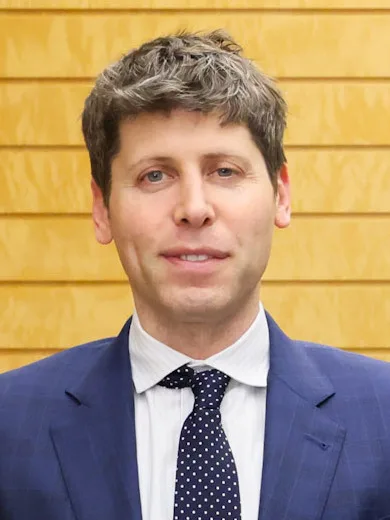
In late 2022, a research company most of the world had never heard of released a chatbot called ChatGPT. Within weeks it had become one of the fastest-adopted products in history, and its chief executive, Sam Altman, became the most visible face of a technological shift now reshaping entire industries. Few executives have moved so quickly from relative obscurity to the centre of a global conversation.
Altman's role is unusual. He is not a research scientist; he is a builder and an allocator of capital and talent, a former startup-accelerator president who spent years spotting and backing founders before deciding to lead the company he believes is building the most consequential technology in history. His job, as he describes it, is to steer OpenAI toward artificial general intelligence — and to try to make it safe on the way up.
From Y Combinator to OpenAI
Before OpenAI, Altman ran Y Combinator, the influential startup accelerator, where he developed a reputation as one of Silicon Valley's sharpest judges of founders and its most connected operators. That vantage point shaped how he approaches OpenAI: less as a laboratory and more as a company that must attract enormous capital, recruit scarce talent, and ship products at a pace that funds the next round of research.
OpenAI itself was founded on an unusual premise — a research organisation whose stated mission is to ensure that artificial general intelligence benefits all of humanity. That mission is baked into an equally unusual structure, and understanding that structure is essential to understanding both the company's rise and its most dramatic crisis.
| Element | Detail |
|---|---|
| Flagship product | ChatGPT — mainstream generative AI assistant |
| Mission | Ensure artificial general intelligence benefits humanity |
| Structure | Capped-profit company governed by a nonprofit board |
| Key partner | A deep, multi-billion-dollar partnership with Microsoft |
| Core tension | Commercial speed versus safety-first caution |
What ChatGPT changed
ChatGPT's significance was not that it was the first large language model — it was that it made the technology tangible to ordinary people. For the first time, anyone could type a question in plain language and get a fluent, useful answer, write code, draft an email, or brainstorm ideas. Adoption was explosive, and within months the product had reshaped expectations across software, education, customer service and creative work.
That mainstream moment set off a race. Every major technology company scrambled to respond, launching rival models and racing to embed generative AI into their products. Altman, almost overnight, went from a respected but low-profile investor to the person the world associated with a technological shift that felt genuinely new — and genuinely destabilising.
The Microsoft partnership
Underpinning OpenAI's rise is its deep partnership with Microsoft, which invested billions of dollars and provided the vast cloud-computing infrastructure needed to train and run frontier models. In return, Microsoft gained privileged access to OpenAI's technology, weaving it into products used by hundreds of millions of people. It is one of the most consequential alliances in modern technology — and, like OpenAI's structure, a source of both strength and tension.
The relationship gave OpenAI the compute and capital to compete at the frontier without building a hyperscale cloud of its own. But it also tied a mission-driven research organisation to the commercial priorities of one of the world's largest companies, sharpening the very question of independence that the nonprofit board was meant to protect.
The structure — and the tension inside it
OpenAI operates as a capped-profit company governed by a nonprofit board, a design meant to let it raise the vast sums that frontier AI requires while keeping the mission — not shareholder returns — formally in control. That structure attracted a deep partnership with Microsoft and billions in funding, and it powered the research that produced ChatGPT and its successors.
But it also created a fault line. The same structure that promised mission-first governance set up a permanent tension between the commercial pressure to move fast and the safety-first caution the mission demands. In November 2023, that tension erupted into the open.
The five days that shook Silicon Valley
In an episode that stunned the technology industry, OpenAI's board abruptly removed Altman as chief executive, citing a loss of confidence. What followed was extraordinary: an overwhelming majority of OpenAI's employees threatened to resign and follow Altman elsewhere; investors and partners applied intense pressure; and within days, Altman was reinstated and the board that had ousted him was reconstituted.
| Moment | What happened |
|---|---|
| The ouster | The board removes Altman, citing lost confidence |
| The revolt | The vast majority of staff threaten to quit in protest |
| The pressure | Investors and partners push hard for his return |
| The reinstatement | Altman returns; the board is reconstituted |
The episode became an instant case study in corporate governance and in the concentration of power inside frontier-AI labs. It exposed how fragile the balance between mission and commerce had become, and how much of OpenAI's value rested on the loyalty of its people and the relationships Altman had built.
The bet is audacious: build the most consequential technology in history, and try to make it safe on the way up.
The compute-and-capital race
Since then, Altman has argued that the path to more capable AI runs through enormous quantities of computing power, capital and physical infrastructure — data centres, chips and energy on a scale that rivals national industrial programmes. He has courted investment and partnerships aimed at securing that compute, positioning OpenAI not just as a research lab but as the anchor of a vast new supply chain.
The numbers involved are staggering, and deliberately so. Altman has spoken about mobilising sums for AI infrastructure that would once have sounded absurd for a single company, on the logic that whoever controls the most compute will control the frontier. It is a bet that the constraint on AI progress is no longer just clever algorithms but raw industrial capacity — chips, power stations, and the buildings to house them — and that securing that capacity early is worth almost any price.
- Frontier AI demands compute, capital and energy at industrial scale.
- Talent and loyalty are as strategic as technology.
- Governance and safety are unsolved, high-stakes problems.
- Whoever controls the models wields extraordinary influence.
That ambition sharpens the question critics keep pressing: who should control a technology this powerful, and by what accountability? Altman has positioned himself as someone trying to answer it responsibly — but the sheer concentration of capability and capital inside a handful of labs makes the question urgent regardless of intent.
The competition closing in
OpenAI no longer has the field to itself. A cluster of well-funded rivals now compete at the frontier: Anthropic, founded by former OpenAI researchers with an explicit focus on safety; Google DeepMind, combining decades of research with the resources of one of the world's largest companies; and a wave of open-weight models that put capable AI in anyone's hands. The result is a race measured in months, where each new model release resets expectations.
For Altman, that competition raises the stakes on every front at once — talent, compute, product and trust. Staying ahead technically requires the best researchers and the most computing power, both of which are scarce and fiercely contested. And the faster the race runs, the harder it becomes to honour the caution the mission demands, because slowing down risks ceding the lead to someone who won't.
What 'AGI' actually means here
Much of the debate around Altman turns on a phrase that appears in OpenAI's mission: artificial general intelligence, or AGI — loosely, an AI system that can match or exceed human capability across most economically valuable work. There is no agreed definition and no consensus on when, or whether, it will arrive. But the belief that it is achievable, and consequential enough to organise a company around, is the animating conviction behind everything OpenAI does.
That conviction is also what makes Altman a polarising figure. To supporters, he is clear-eyed about a transformation that will reshape the economy, and is trying to shepherd it responsibly. To critics, the AGI framing can read as hype that justifies raising enormous sums and moving fast on a technology whose risks are poorly understood. Altman himself tends to hold both ideas at once — insisting the upside is immense while warning, more than most of his peers, that the technology demands unusual caution.
What comes next
Altman's defining challenge is to keep OpenAI ahead technically while proving that a company can operate at the frontier without treating safety as an afterthought. On his own account, he holds little or no equity in OpenAI; his personal wealth comes largely from venture investments, and estimates of it vary widely. The more meaningful measure of Altman is influence, not net worth — and by that measure, few people alive today are shaping the near future as directly. The next few years will determine whether that influence produces a technology that broadly benefits people, or one whose risks its own creators struggle to contain.