
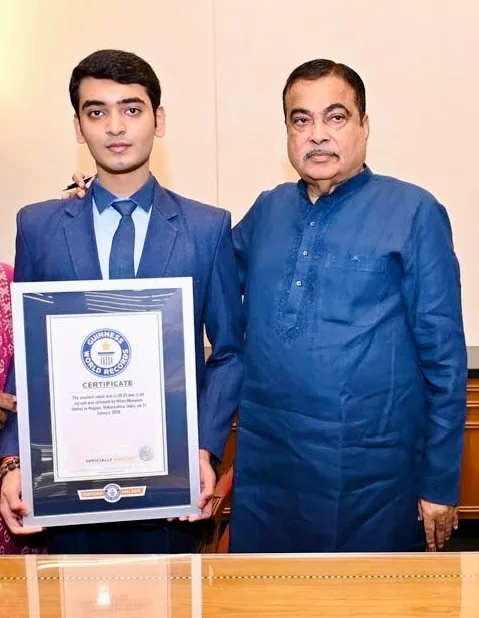
What can a 17-year-old with a home workshop, an Arduino microcontroller and a refusal to accept limitations achieve? Two Guinness World Records, a sign language translation app, and recognition from a Union Minister — for starters.
Hiten Dharpure from Nagpur, Maharashtra, is not waiting for a degree, a lab or institutional backing to build things that matter. Working with accessible technology and open-source tools, he has already established himself as one of India's most remarkable young innovators.
The World's Smallest Robotic Arm
On 17 January 2026, Dharpure set a Guinness World Record by creating the world's smallest functional electro-mechanical robotic arm, measuring just 39.25 mm — roughly the size of a fingertip. The device broke the previous record of 44.49 mm, held by Kelton Serra of Indiana, USA, by more than 5 mm.
The miniature arm features a custom 3D-printed body and baseplates designed using CAD software, an Arduino microcontroller programmed in C/C++, a PWM control module for precise movement and micro-servos. Despite its tiny size, it offers independent three-axis movement and can accurately grip and transport small objects — mirroring the functionality of full-scale industrial robotic arms.
Dharpure spent nearly two months on research, testing and refinement before achieving the final design. Every component was sourced from readily available materials — a deliberate choice to demonstrate that world-class innovation does not require expensive equipment or institutional resources.
The World's Smallest Weather Station
Dharpure's first Guinness World Record came on 22 April 2025, when he built the world's smallest weather station — measuring just 74 mm long, 44 mm wide and 60 mm high. Small enough to fit in the palm of a hand, the device measures humidity, temperature and air pressure with functional accuracy. He also received a registered copyright for the station's software.
HastaVaani: Technology for Accessibility
Beyond miniaturisation, Dharpure has directed his skills toward social impact. HastaVaani is an offline mobile application that translates Indian Sign Language (ISL), making communication more accessible for the hearing-impaired community. The app's offline capability is a critical design choice — it ensures functionality in areas with limited or no internet connectivity, extending its reach to the communities that need it most.
This project reveals a dimension of Dharpure's work that goes beyond technical novelty. He is not building for the sake of records alone. He is thinking about who his technology can serve and how it can solve real problems.
Recognition
Dharpure's achievements have drawn recognition from prominent figures, including Union Minister Nitin Gadkari, who personally honoured him in Nagpur and encouraged him to continue his work in innovation. He has also been recognised as part of the broader conversation around India's emerging young innovators — a group that is challenging assumptions about what age, location and resources should determine.
A Record Every Year
Dharpure has set himself a personal goal: to challenge himself by setting a new global innovation record every year. It is a bold ambition for anyone, let alone a teenager. But given that he has already achieved two world records before turning 18, the target feels less like aspiration and more like trajectory.
His story carries a message that extends beyond robotics or engineering. It is proof that world-class innovation can emerge from a home workshop in Nagpur, built with accessible technology, driven by curiosity and validated by the highest global standards. Age, it turns out, is not a prerequisite. Neither is a lab, a degree or a venture-backed budget. What matters is the willingness to build.