
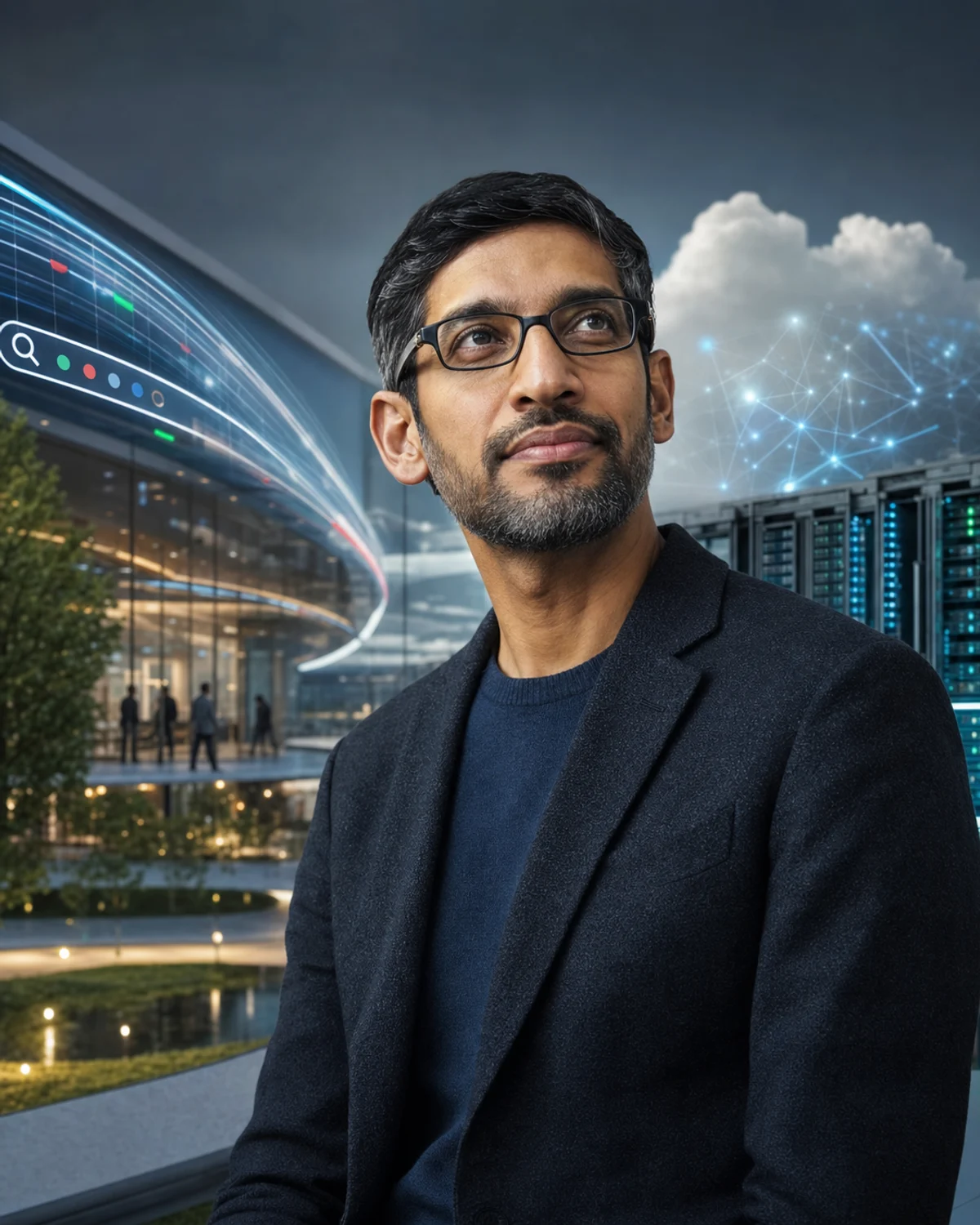
Google was the gatekeeper for twenty years. Almost every journey online began in that search bar, and the business model built on it was close to perfect. Then ChatGPT arrived in late 2022 and the certainty evaporated inside a month. This was not a competing product. It was a different answer to the question Google had owned since 1998, and Sundar Pichai declared a Code Red.
He is not a disruptor and has never pretended otherwise. What he is, unusually, is a technical product leader who became chief executive of a four-trillion-dollar company without breaking the culture underneath him. Understanding how Google is defending itself now means understanding the diplomat who spent a decade quietly preparing for exactly this.
| Detail | Information |
|---|---|
| Born | June 10, 1972, Madurai, Tamil Nadu, India |
| Education | BTech, IIT Kharagpur; MS, Stanford University; MBA, Wharton School |
| Before Google | Applied Materials; McKinsey & Company |
| Company | Alphabet Inc. — CEO since 2019 (Google CEO since 2015) |
| Key Metric | Alphabet Market Cap: ~$4 Trillion (2026) |
| Known for | Google Chrome, 'AI-First' pivot, Gemini integration |
From Madurai to the Mountain View
Madurai, in southern Tamil Nadu, is a temple city. He grew up there in a middle-class household with an electrical engineer for a father, and the family story people always repeat is about how long they waited for a telephone. The curiosity was quiet and relentless. It took him to IIT Kharagpur, to study metallurgical engineering.
America changed the trajectory. Materials science at Stanford, then an MBA at Wharton — a combination that left him able to hold a real conversation in the server room and another one in the boardroom, which almost nobody can do. He joined Google in 2004 as a product manager rather than a founder or a star engineer. That job turned out to be the advantage.
The 'Chrome Bet': Securing the Entry Point
Browsers were somebody else's problem, as far as Google was concerned in the early 2000s. Internet Explorer held the market, and the most popular search engine in the world reached its users entirely through software it did not control. One decision by one browser maker — change the default — and the traffic could disappear.
Pichai's answer was to build a browser. Senior leadership disliked it, on the reasonable grounds that a browser is expensive, slow to build and a distraction from search. He kept arguing. What he described was not a window onto the web but a fast, minimal, secure platform that would make websites behave like installed applications.
Chrome shipped in 2008 and settled the question. Winning the browser war put a moat around Search, because the entry point to the internet for billions of people now belonged to Google. It also settled a smaller question internally: Pichai was the company's best product leader, and the route to the top job opened from there.
The most dangerous place for a company to be is dependent on someone else's platform for your primary source of growth.
The AI-First Pivot: A Decade in the Making
By 2015, when he took over Google, mobile was won and the next shift was already visible to anyone paying attention. A year later he said it out loud: the company was no longer mobile-first. It was AI-first.
That was a budget decision dressed as a slogan. While everyone else built apps, Pichai spent on the infrastructure of intelligence — accelerating Tensor Processing Units, custom silicon made for machine learning, and folding DeepMind's research into ordinary Google products. The destination was a world where you stop searching for a link because the answer simply arrives.
For years none of it was visible. AI sorted spam in Gmail, chose routes in Maps, ranked results in Search. Then ChatGPT launched and the long-term vision became an emergency. The Code Red was really an admission: Google had the better research and had been too careful to ship it, because a generative answer eats the advertising slots that pay for everything.
| Era | Strategic Focus | Key Technology |
|---|---|---|
| Search Era | Indexing and Ranking | PageRank |
| Mobile Era | Accessibility and Apps | Android |
| AI-First Era | Reasoning and Generation | TPUs, Gemini, LaMDA |
| Agentic Era | Action and Execution | Gemini Agents, Project Astra |
The Gemini Era and the Battle for the Answer
His answer was to stop the company competing with itself. Google Brain and DeepMind — two of the strongest AI labs in the world, both inside the same firm, both convinced they should lead — were merged into Google DeepMind. The internal rivalry ended and every researcher was pointed at the same target.
Gemini came out of that, built natively multimodal rather than retrofitted: text, images, video and code handled together. The deployment strategy was breadth. AI Overviews in Search, drafting help in Docs, assistance folded into products people already open every morning until the AI is simply part of the furniture.
It has been bumpy in public. Early AI Overviews hallucinated in ways that made headlines, and the balance between accuracy and fluency is still being negotiated. His confidence rests on infrastructure rather than models — a long lead in custom silicon and an index of the entire web, which he argues makes Google the only company that can serve AI to billions of people without the cost collapsing on it.
Leadership by Consensus: The Diplomat CEO
He is the opposite of the celebrity chief executive. No provocative posts, no grand declarations, very little visible ego. What he does instead is build consensus — and inside an organisation of thousands of brilliant, argumentative engineers, getting them pointed the same way is not a soft skill. It is the job.
Critics call the same quality hesitation, and say Google grew too large to take a real risk. His defenders point at the docket: antitrust cases in the United States and Europe, privacy regimes on three continents, and a four-trillion-dollar business to keep steady through all of it. Someone louder might not have survived the decade.
The Innovator's Dilemma and the Cost of Dominance
The innovator's dilemma has defined his tenure. Search advertising is one of the most profitable machines ever built, and a generative answer removes the ad slots that machine depends on. Year after year, the internal calculation favoured protecting the revenue over shipping the technology.
That caution handed OpenAI the public imagination, which a startup with no revenue to protect was free to take. What he has to prove now is that one company can be both a dependable utility and a genuine innovator. The contest is not really about who trains the best model any more. It is about who can put that model inside a useful product without dismantling the business that funds it.
What Founders Can Learn from Sundar Pichai
- Protect the Entry Point. The 'Chrome Bet' proves that whoever controls the gateway to the user controls the destination. Never let a third party own your primary acquisition channel.
- Invest in the Invisible. Google's lead in AI wasn't just about the models, but the TPUs and data centers built years before the boom. Long-term infrastructure is the ultimate moat.
- Manage the Innovator's Dilemma. Be willing to cannibalize your own product before a competitor does it for you. Hesitation in the face of disruption is a terminal risk.
- The Power of Consensus. In large organizations, the ability to align people is more valuable than the ability to command them. Diplomacy is a scaling strategy.
- Product Craft Over Persona. You don't need to be a 'visionary' celebrity to lead a global empire. A relentless focus on the user experience and product excellence is enough.
The Horizon: Beyond the Search Bar
As we move toward 2027, the definition of 'search' is changing. We are moving from a world of keywords to a world of agents—AI that doesn't just find information, but executes tasks. Pichai's vision for Gemini is to transform Google from a search engine into a personal agent that can plan a trip, manage a calendar, and write code in real-time.
The stakes could not be higher. If Google succeeds, it remains the central nervous system of the digital economy. If it fails, it becomes the next cautionary tale of a giant that was too big to pivot. For Sundar Pichai, the journey from a small house in Madurai to the helm of Alphabet has been a climb of steady, calculated ascent. Now, he is leading the company through its most volatile descent into the unknown of the AI era.
Sources and editorial references
This profile is based on Alphabet Inc.'s official investor relations and financial reports, public interviews with Sundar Pichai, and reporting from established business and technology publications. Financial figures for 2026 are based on projected market capitalizations and reported earnings.
- Alphabet Inc. — Investor Relations: abc.xyz
- Google Blog — Message from the CEO: blog.google
- Wikipedia — Sundar Pichai: wikipedia.org
- Business Insider — Career Rise of Sundar Pichai: businessinsider.com