
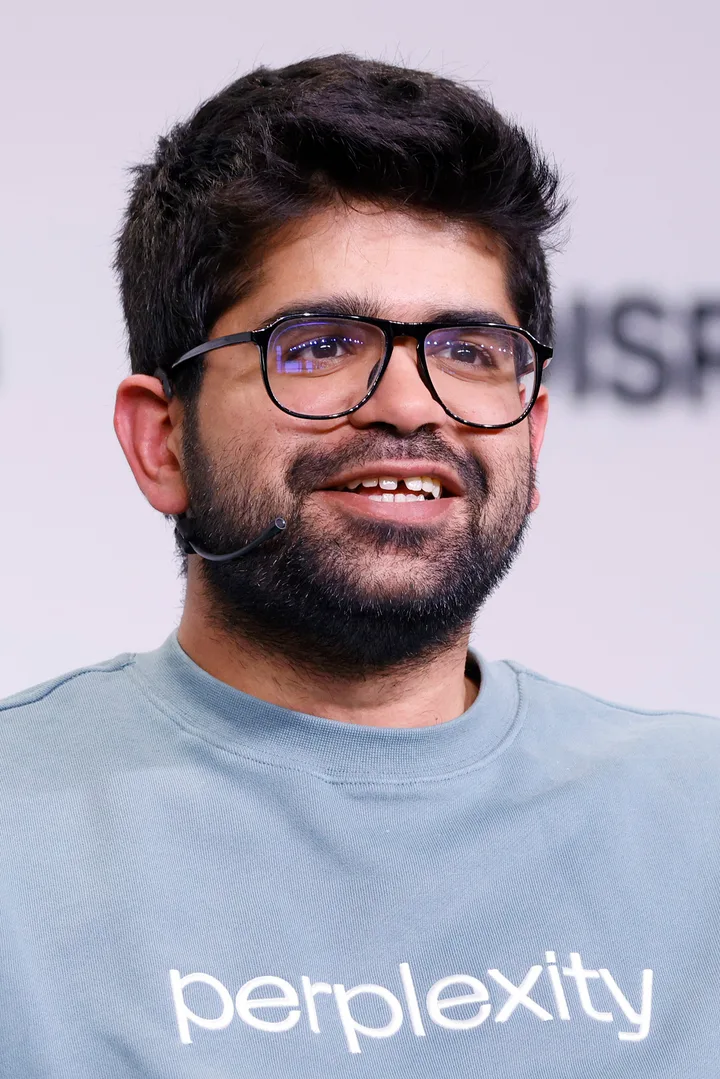
The blue link ran the internet for twenty-five years. You typed a question into a box and got back a list of places the answer might be hiding — a system of pointers, and everyone accepted it because there was nothing else. Aravind Srinivas decided in 2022 that pointing was no longer good enough. He did not want to help you find the information. He wanted to hand you the answer.
Perplexity AI reads the web rather than merely indexing it, running live results through large language models until searching feels like asking a person. That is a product decision with a much larger consequence attached, because a tool that answers directly is an attack on the revenue model of the most powerful company on the internet.
| Detail | Information |
|---|---|
| Born | 1994, Chennai, India |
| Education | IIT Madras (BTech/MTech); UC Berkeley (PhD candidate) |
| Previous Roles | DeepMind; Google Brain; OpenAI |
| Company | Perplexity AI — Co-founder and CEO since 2022 |
| Key Metric | Valuation: ~$18 Billion (2025/26) |
| Known for | The 'Answer Engine' concept, Inline citations, Orchestrator thesis |
From the Labs of Chennai to Berkeley
He is a product of the pipeline that moves Indian technical talent into global AI. Chennai first, then IIT Madras, where he studied electrical engineering and spent his real attention on machine learning — teaching machines to find patterns and guess what comes next.
Berkeley came after, for a PhD in computer science, and he arrived just as generative AI began to accelerate. Years went into making models faster and more accurate, which builds a particular kind of intuition. He knew how the magic worked underneath. More usefully, he knew exactly where it failed.
The 'Big Three' Apprenticeship
Then came an apprenticeship few people get. Google Brain, DeepMind, OpenAI — research roles at all three of the most consequential AI labs in the world. At Google he worked on models that would end up inside Search. At OpenAI he worked on early DALL·E 2.
Seeing all three from the inside showed him what none of them were looking at. Every lab was racing to make the model bigger and more capable. Nobody was thinking hard about the interface — how a person actually asks for something and receives an answer they can trust. His conclusion was that the base model would not hold the value. The layer that orchestrates models into a truthful, cited response would.
The world doesn't need another LLM; it needs a way to actually use those models to get the truth without the hallucination.
The Answer Engine: Disrupting the Blue Link
Perplexity was founded in August 2022 to replace search-and-click with ask-and-receive. It reads the top results, writes them into a single coherent answer, and cites every claim inline — that last part being the detail everything else depends on.
Citations fixed the two things wrong with early generative AI: nobody could tell where an answer came from, and the model made things up. Anchor each sentence to a real source and the tool stops being a creative writer and becomes a research assistant. Users loved it. Incumbents did not, for an obvious reason — a person who already has the answer has no reason to click a link, and the ad-supported web is built entirely on that click.
| Feature | Traditional Search (Google) | Answer Engine (Perplexity) |
|---|---|---|
| Primary Output | List of ranked links | Synthesized narrative answer |
| User Effort | High (Click, Read, Filter) | Low (Read synthesized result) |
| Verification | Manual (Visit multiple sites) | Immediate (Inline citations) |
| Business Model | Ad-clicks (PPC) | Subscription / API / Revenue Share |
| Core Tech | Indexing & Ranking | LLM Orchestration & RAG |
The Orchestrator Thesis: Scaling Without the Billions
The orchestrator thesis is the provocative part. Google and OpenAI spend billions training monolithic base models; Perplexity declined to compete there. Srinivas's argument is that base models commoditise, and once they do the value moves to whoever routes each query to whichever model handles that particular job best.
That let the company scale on a fraction of its rivals' capital. Managing existing intelligence rather than growing your own means you can rework the product and the Deep Research agents far faster than a lab can retrain weights. The efficiency attracted Jeff Bezos and Jensen Huang as backers, and carried the valuation to roughly $18 billion by late 2025.
The Publisher War and the Ethics of Synthesis
The backlash was fierce and not unreasonable. Perplexity's answers are complete enough that few readers bother visiting the source, and publishers noticed. Forbes and Condé Nast among others accused the company of scraping their work and taking their traffic — of treating the web as a free database underneath a paid product.
His answer has been half defiance, half diplomacy. The blue-link era was dying anyway, he argues, and publishers who wait for it to return will wait a long time. The concession is a revenue-sharing pilot that pays publishers cited in answers. Call it a truce in a much longer argument about who owns the value of information once a machine can summarise it.
Leadership: Regret Minimization and the One-Person Unicorn
He runs on regret minimisation. At 27, weighing academic research and a safe job at a large lab against starting something, he asked whether an eighty-year-old version of himself would regret not trying. The answer was obvious enough to act on, and it explains a speed that is unusual for someone with his academic background.
He also argues, loudly, for the one-person unicorn. His claim is that AI has collapsed the cost of labour far enough that ten people can build a ten-billion-dollar company, and that India in particular should notice. Less managerial hierarchy, more small teams using AI to reach a scale that used to require thousands of employees.
What Founders Can Learn from Aravind Srinivas
- Build the Orchestrator, Not Just the Model. In a world of commoditized AI, the value is in how you route, synthesize, and present the information to the user.
- Use the Regret Minimization Framework. When facing a high-risk pivot, project yourself forward in time to clarify the cost of inaction.
- Solve for the 'End State.' Perplexity didn't just make search better; it imagined a world where the 'search' part was gone and only the 'answer' remained.
- Leverage Academic Pedigree for Market Trust. Srinivas's background in the top AI labs gave Perplexity immediate credibility in a market flooded with 'AI wrappers.'
- Anticipate the Regulatory and Ethical Backlash. If your product disrupts an existing revenue stream (like publishers), have a plan for revenue sharing or partnership before the lawsuits arrive.
The Horizon: From Answer Engine to AI Computer
An answer engine is what exists today. What he describes next is an AI computer — a layer that does not merely tell you the answer but carries out the work. Book the itinerary. Run the market analysis. Finish the set of tasks. Synthesis becomes action.
In the fight over the front page of the internet, Perplexity's advantage is that it owes nothing to advertising. No legacy revenue to protect means no reason to hesitate, which is exactly the position Google cannot occupy. Getting from IIT Madras to an $18 billion company was the easier half. The harder question is whether an answer engine survives becoming something that acts on your behalf.
Sources and editorial references
This profile is based on interviews with Aravind Srinivas, Perplexity AI's official company announcements, and reporting from Fortune, Forbes, and the Financial Express. Financial figures reflect the most recent funding rounds and valuation estimates from late 2025.
- Perplexity AI — Official Site: perplexity.ai
- Fortune — Will Perplexity Kill Google?: fortune.com
- Forbes India — Aravind Srinivas on AI Entrepreneurship: forbesindia.com
- Financial Express — The Story of Perplexity AI CEO: financialexpress.com