
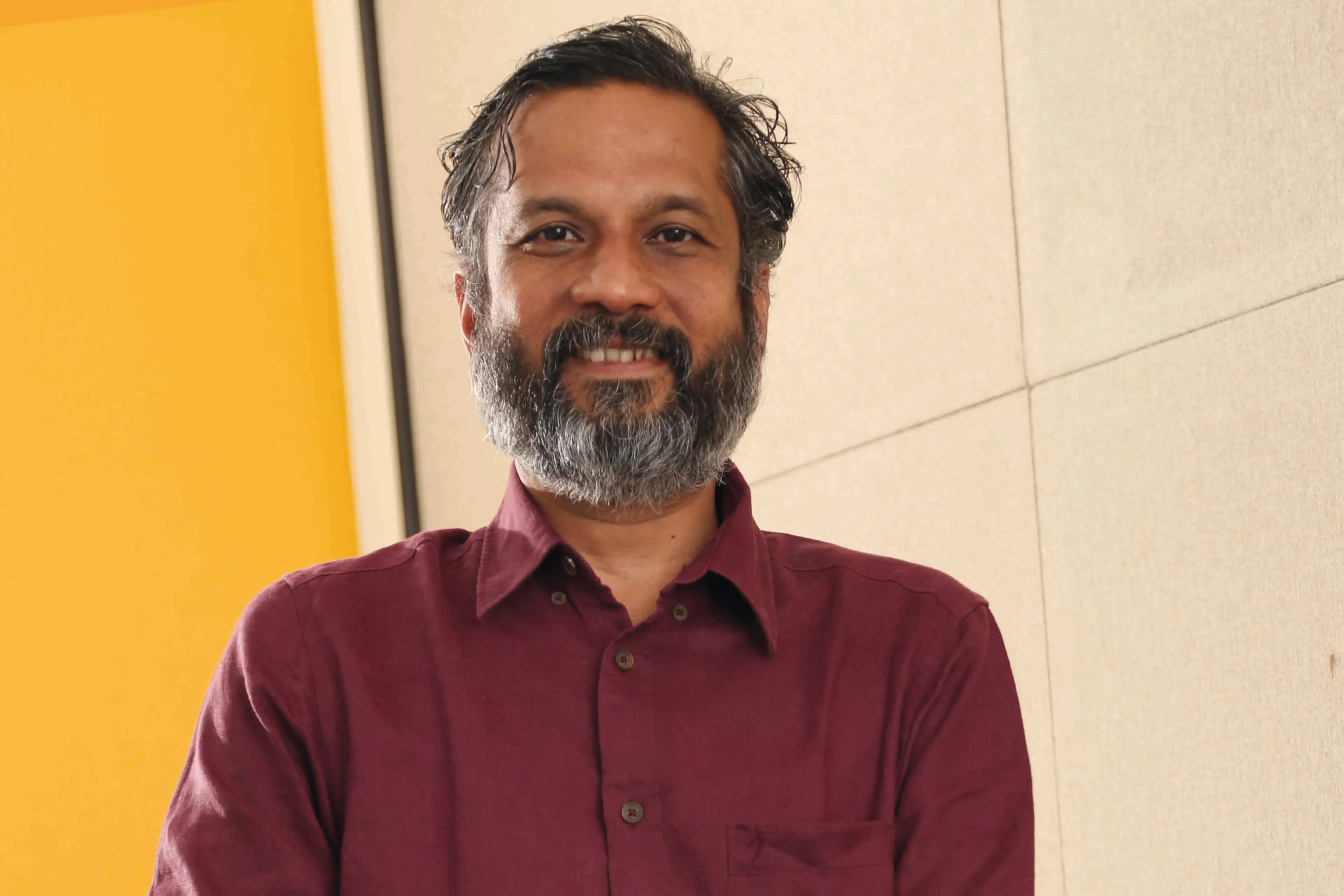
Silicon Valley keeps score with funding rounds and exit multiples. Sridhar Vembu keeps score differently, from Mathalamparai — a village in the Tenkasi district of Tamil Nadu, where he lives and works in a dhoti and runs a global software company that has never taken a cent of venture capital.
The industry calls him the anti-CEO, which is lazy but not wrong. While SaaS peers spent billions buying users, Zoho grew for three decades on its own cash. The rural part is the more interesting experiment: a wager that the next wave of software will come out of Indian villages rather than a campus in Palo Alto, and that the only reason it hasn't is that nobody put the work there.
| Detail | Information |
|---|---|
| Education | BTech, IIT Madras; MS & PhD, Princeton University |
| Founding | AdventNet (1996), renamed Zoho (2009) |
| Current Role | Chief Scientist, Zoho Corporation |
| Key Metric | Revenue: ₹8,703 Cr (FY23); Net Profit: ₹2,836 Cr |
| Philosophy | Bootstrapped, Rural-First, Vocational Learning |
| Known for | Zoho One, Rural Offices, Zoho Schools of Learning |
From Princeton to the Long View
The training behind all this is conventional and formidable. IIT Madras, then Princeton for a master's and a PhD in electrical engineering, then Qualcomm as a wireless engineer. That last job matters most. It taught him the internet's plumbing — the invisible connectivity layers that everything else is stacked on.
AdventNet came in 1996, selling network management software to IT administrators who needed to watch their systems. Then the web stopped being pages and started being applications. Vembu drew the obvious conclusion before most did: what businesses would eventually want was not a better monitoring tool but a full set of applications for running the whole company.
The 2009 rename to Zoho marked the move to the cloud. CRM, email, accounting, project management — dozens of apps, built in-house, designed to talk to each other. That is where the 'operating system for business' idea starts, and it ends years later in Zoho One.
The Bootstrapped Moat: Independence as a Strategy
Independence is the whole company, really. Unicorn status is usually a measure of money raised; Zoho qualifies having raised none. Vembu turned down multi-million dollar term sheets on the argument that outside capital is never only capital — it arrives with a clock attached, and the clock always favours this quarter over next decade.
The moat that produced is patience. No board is waiting on a 10x, so Zoho can spend years on a product with no obvious market, or open offices in villages that will not show a return for a long time. Competitors pivoting every six months to justify the next round eventually run out of story. Zoho does not have a story to maintain.
VC funding is like a drug; it feels great at first, but it changes your DNA. Once you take it, you are no longer building a business—you are building an exit.
Rural Revival: Moving Work to the People
His most ambitious project is not software. Vembu's argument is that urban clustering — all the talent and all the money piled into Bengaluru or San Francisco — is a broken arrangement that drains villages and chokes cities at the same time. Both ends lose.
So he moved. His own base went to a small Tamil Nadu village, and Zoho opened hubs across rural and semi-urban India. The premise fits in one line: rather than make a talented kid leave the village for the job, take the job to the village. Good infrastructure, well-paid engineering work, salaries spent locally — and a social fabric that stays intact because nobody had to leave it.
| Dimension | Traditional Path | Zoho Schools Path |
|---|---|---|
| Entry requirement | University degree | Open to school-leavers, no degree needed |
| Learning method | Theoretical and academic | Apprenticeship on live products |
| Cost | High tuition fees | No tuition fee |
| Outcome | A degree, then a job search | Trained directly into a role |
| Focus | Academic credentials | Practical skill and craft |
| Result | Standardised talent | Contextual experts |
The 'Operating System for Business' Strategy
Salesforce went deep on one category and owned it. Vembu went wide. The ambition was a single platform a business could run entirely on, which became Zoho One — dozens of applications sold as one thing. Finance to HR in one place is not a glamorous pitch, and it is extremely hard to leave once you are inside it.
Integration is the actual product. A lead lands in CRM, a project opens in the project tool, a draft invoice appears in accounting, and nobody re-types anything. Companies assembled from acquisitions cannot do this — their tools were built by different people to different assumptions. Zoho can, because Zoho wrote all of them.
Challenges: The Marketing Gap and the Global Scale
The permanent problem is that not enough people have heard of it. Zoho does not spend like Microsoft or Salesforce, so for years it grew on word of mouth and the fact that the products were good. That works beautifully in the mid-market. It works badly at the top of the enterprise, where a CIO buys the brand that will not get him fired.
Running a global company out of rural India adds its own friction. Time zones, distance, no headquarters exerting a centripetal pull on the culture. Vembu's answer has been to lean harder into the vocational model and trust people to run themselves — which works only if you hired for that in the first place, which is what the schools are for.
What Founders Can Learn from Sridhar Vembu
- The Freedom of Bootstrapping. Total ownership means total control. If you can survive on your own cash flow, you can make decisions that are right for the product, not just the investors.
- Talent is Everywhere; Opportunity is Not. By looking for talent in non-traditional places (like rural villages), you can find loyal, high-performing employees who are overlooked by the competition.
- Build an Ecosystem, Not a Product. Don't just solve one problem; solve the entire workflow. An integrated suite of tools is far harder to replace than a single-purpose app.
- The Power of the 'Slow' Growth Strategy. Sustainable, organic growth often leads to a more resilient company than the 'blitzscaling' approach of VC-funded startups.
- Value Craft Over Credentials. A person who can build a working feature is always more valuable than a person who can describe the theory of how it should work.
The Horizon: AI and the Decentralized Future
As Chief Scientist he has moved to the AI question, and he is not interested in bolting features onto existing screens. The version he describes has agents running business processes on their own — the software doing the operating, humans left with the judgement calls. Whether that arrives on schedule is unknowable. That he will fund it out of profits rather than a round is not.
Princeton to a Tamil Nadu village is an unusual career arc, and the point of it is that the Silicon Valley playbook was always optional. Vembu built a profitable global software company while paying rural engineers well and taking money from nobody. Compassionate capitalism is the phrase people reach for. Zoho's balance sheet suggests it was also just good business.
Sources and editorial references
This profile is based on Zoho's official corporate communications, public interviews with Sridhar Vembu, and reporting from Forbes India and the Times of India. Financial figures reflect the FY23 consolidated reports of Zoho Corporation.
- Zoho Official Site: zoho.com
- Forbes India — The Bootstrapped Buddhist: forbesindia.com
- Times of India — Sridhar Vembu's Career Path: timesofindia.indiatimes.com
- Wikipedia — Sridhar Vembu: wikipedia.org