
The most successful companies are often born from a trivial observation. For Deepinder Goyal, that observation was a line of hungry consultants at a Bain & Company office in New Delhi, all waiting to browse a few physical restaurant menus. It was a small, inefficient friction in a workday, but to Goyal, it was a market signal. He didn't set out to disrupt the global food economy; he just wanted to make it easier for his colleagues to decide where to eat.
That simple utility evolved into Foodiebay, and then into Zomato—a brand that would eventually redefine the relationship between Indians and their food. From a menu directory to a delivery giant, and finally to the architect of a conglomerate called Eternal Ltd, Goyal's journey is a masterclass in operational scaling. He proved that in the digital economy, the winner isn't necessarily the one with the best idea, but the one who can execute the most complex logistics at the highest speed.
| Detail | Information |
|---|---|
| Education | B.Tech, IIT Delhi (Math & Computing) |
| Before Zomato | Management Consultant, Bain & Company |
| Company | Zomato / Eternal Ltd — Founder & Vice Chairman |
| Key Milestone | Zomato IPO (2021), Blinkit Acquisition (2022) |
| Net Worth | Estimated ~$1.4 Billion (2026) |
| Known for | Hyper-local scaling, Quick Commerce, Direct communication |
The Menu Directory: The Power of a Small Utility
In 2008, 'food-tech' didn't exist in India. The primary way to find a restaurant was through word-of-mouth or a physical directory. When Goyal launched Foodiebay, he focused on a single, high-value utility: digitizing menus. By scanning and uploading menus to a simple website, he solved a real problem for a specific group of people. This 'wedge strategy' allowed him to build a massive database of restaurant information without the overhead of a delivery fleet.
The transition from Foodiebay to Zomato in 2010 was a strategic rebranding designed to move the company beyond the 'bay' of menus and into the broader world of food discovery. Zomato became the 'Yelp of India,' focusing on user reviews, ratings, and high-quality imagery. By the time the company expanded internationally into the Middle East and Southeast Asia, it had established a moat of user-generated content that made it the default destination for anyone looking to eat out.
The Delivery Pivot: Fighting the Logistics War
For years, Zomato was a discovery platform. But as the 'convenience economy' took hold, the company realized that discovery was only half the battle. The real value lay in the transaction. Between 2015 and 2019, Zomato pivoted into a full-stack delivery service. This was the most dangerous period in the company's history: it shifted from a high-margin software business to a low-margin, high-complexity logistics business.
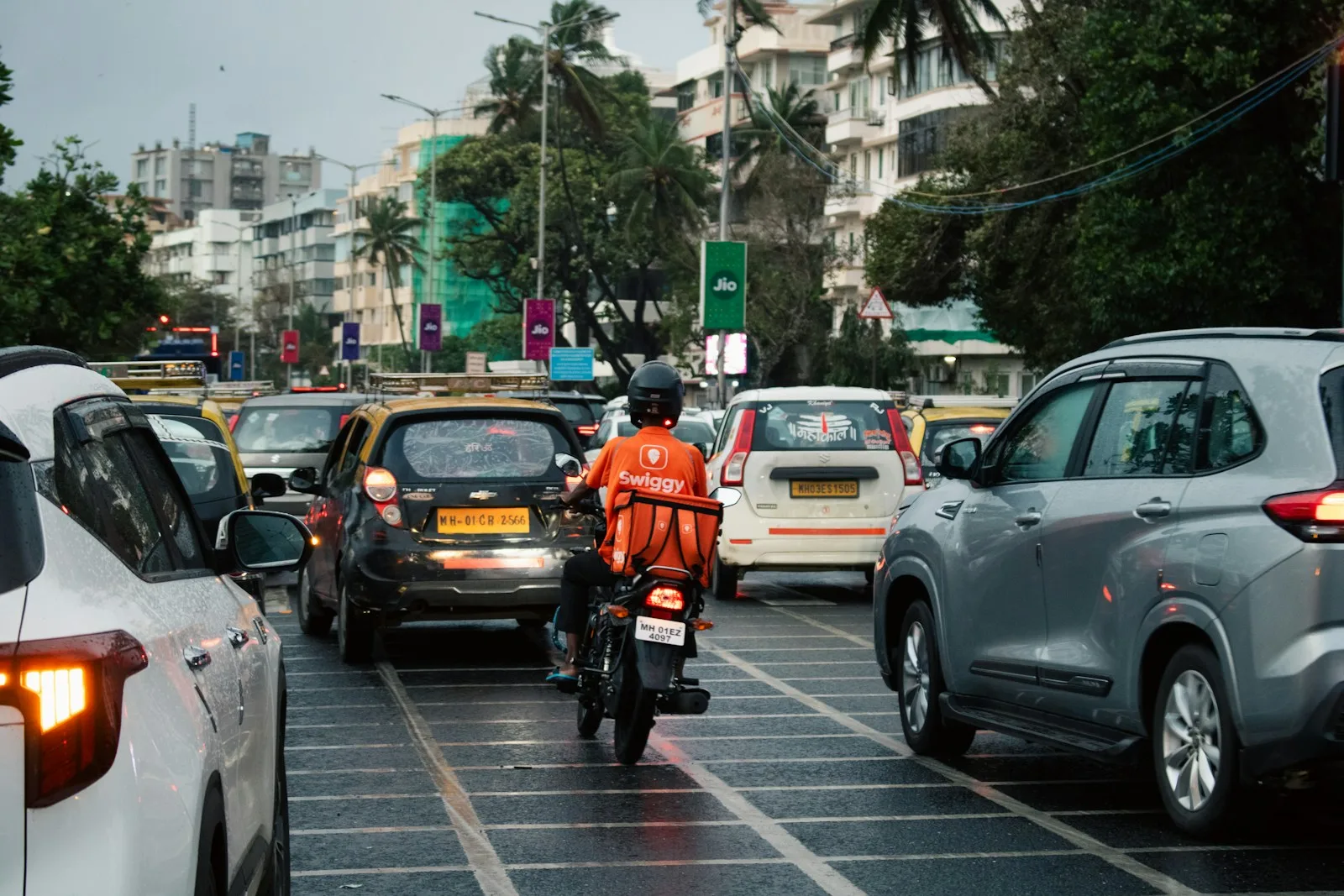
The battle with Swiggy was a war of attrition. Both companies burned billions in venture capital to acquire users through deep discounts, fighting for every single order. This era of 'hyper-growth' was a brutal lesson in unit economics. Goyal had to transform himself from a product visionary into a full-stack operator, managing thousands of delivery partners and optimizing delivery routes in real-time across some of the most congested cities in the world.
Scaling a delivery business is not about the app; it's about the asphalt. The real win happens in the last mile, not the first click.
The Blinkit Bet: From Meals to Minutes
By 2022, the food delivery market had reached a plateau of maturity. To continue growing, Goyal looked toward 'quick commerce'—the delivery of groceries and essentials in under ten minutes. This led to the $568 million acquisition of Blinkit. It was a bold move that signaled the end of Zomato as just a 'food app' and the beginning of its transformation into a 'utility app.'
The Blinkit acquisition allowed Zomato to leverage its existing logistics network to dominate the 'dark store' model. By placing small warehouses in dense urban neighborhoods, Zomato could deliver a bottle of milk or a pack of batteries faster than a user could walk to the corner store. This pivot expanded the company's addressable market from 'dinner' to 'everything,' increasing the frequency of user interaction and diversifying the revenue stream.
| Entity | Primary Function | Strategic Role |
|---|---|---|
| Zomato | Food Delivery & Discovery | Core consumer interface and brand |
| Blinkit | Quick Commerce | High-frequency utility and grocery |
| Hyperpure | B2B Supplies | Supply chain control and quality assurance |
| District | Dining Out & Events | Capturing the 'going out' economy |
Leadership: Directness and the Public Eye
Deepinder Goyal's leadership style is a departure from the polished, PR-managed personas of most Indian CEOs. He is famously direct, often using social media to address critics or announce new features in a raw, unfiltered manner. This 'founder-led' communication strategy has created a strong, if sometimes polarizing, brand identity. He is viewed as a leader who values speed and truth over corporate optics.
However, the transition to a public company in 2021 brought new pressures. As a listed entity, Zomato's every move was scrutinized by the markets. Goyal had to balance his instinct for 'high-risk exploration' with the quarterly demands of shareholders. This tension eventually led to the creation of **Eternal Ltd**, a holding company structure that allows Zomato and Blinkit to operate with their own specialized leadership while Goyal maintains strategic oversight as Vice Chairman.
What Founders Can Learn from Deepinder Goyal
- Start with a Small Utility. You don't need to build a conglomerate on day one. Start by solving a tiny, specific friction (like menu scanning) and expand from there.
- The Power of Strategic Consolidation. The acquisition of Uber Eats India showed that in a two-player war, the winner is often the one who can consolidate the market first.
- Pivot Based on User Behavior. Zomato didn't decide to do delivery in a vacuum; they saw the user's desire for convenience and pivoted their entire business model to meet it.
- Embrace the 'Holding Company' Model. As you scale, avoid the 'conglomerate discount' by structuring your businesses as a portfolio of specialized entities under a single strategic vision.
- Direct Communication is a Moat. In an era of corporate speak, a founder who speaks directly and honestly to their users builds a level of trust that no marketing budget can buy.
The Horizon: Biohacking and the Future of the Operator
In a surprising twist, Goyal's latest obsession is not with food, but with the human body. After stepping down as CEO of Eternal, he has pivoted his focus toward longevity science and 'biohacking.' Through ventures like Continue Research and Temple, he is applying the same operational rigor he used to scale Zomato to the problem of human health and lifespan.
Scanned menus in a cafeteria, then a multi-billion dollar conglomerate, now the limits of human biology. What connects those is the operator's instinct: take a messy real-world problem and build a system that solves it at scale. On the evidence of his career, that remains the most valuable skill going.
Sources and editorial references
This profile is based on Zomato's official investor relations, public interviews with Deepinder Goyal, and reporting from Forbes India, NDTV Food, and YourStory. Financial data reflects the 2025/26 fiscal reports of Eternal Ltd.
- Zomato Investor Relations: zomato.com/investor-relations
- Forbes India — The Eternal CEO: forbesindia.com
- YourStory — Humility, Hunger and Humour: yourstory.com
- NDTV Food — From Menus to Markets: food.ndtv.com