
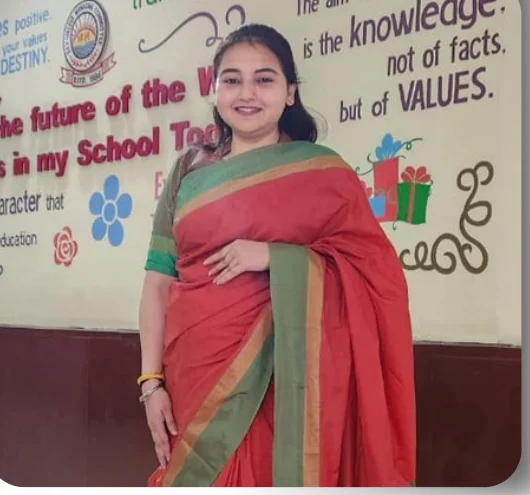
For Aastha Soni, teaching has never been limited to books, lesson plans or classroom routines. Her journey as an Early Years Educator has grown around creativity, patience, continuous learning and the belief that every child deserves a positive beginning to education. She completed her schooling at Queen Mary's School in Delhi before pursuing a B.Sc. in Life Sciences from Swami Shraddhanand College, University of Delhi, followed by a B.Ed. from MDU and Nursery Primary Teacher Training from Lal Bahadur Shastri Training Institute.
From volunteering to a permanent teaching role
Her connection with teaching began much before her formal career — while studying in college, she earned by helping children with school projects and tuition, and volunteered with NGOs teaching Art and Craft without charging a fee. Aastha formally entered teaching in 2015 with Mother's Pride, later worked with Prudence and GD Goenka, and joined DAV Nursery School in 2018, where she now works as a permanent Nursery Teacher.
Beyond the classroom: sustainability and school life
Over the years, her role has grown beyond regular classroom teaching. She is associated with both the Art and Craft Team and the IT Team at school, has contributed to planning the school's annual activity planner for four years, and independently prepared the Annual Report for the 2025–26 academic session. As Sustainability In-charge, she coordinated activities connected with the Wipro Earthian Sustainability Project — recognised among the Top 10 schools in Delhi — and received recognition for her role as project coordinator, alongside the Teachers of Tomorrow Award and the Vidyasagar Leadership Award.
Beyond school, Aastha shares her experiences through her Instagram page, @aasthasoniofficial, creating content around teaching, classroom activities and educator life.
Sustainability programming in early childhood education
Early years and pre-primary education in India has increasingly folded sustainability and environmental awareness into its activity planning, partly driven by corporate-backed initiatives like the Wipro Earthian Sustainability Project that Aastha coordinated, which explicitly reward schools for embedding environmental projects into everyday student life rather than treating them as one-off assembly topics. For the pre-primary and Balvatika age group specifically — a stage the National Education Policy 2020 formally brought under structured foundational learning for the first time — sustainability concepts are typically introduced through sensory, hands-on activities (planting, recycling crafts, nature walks) rather than instructional content, which places significant weight on a teacher's ability to design age-appropriate projects rather than deliver a fixed syllabus.
The range of responsibilities Aastha holds beyond classroom teaching — sustainability coordination, annual reporting, newsletter production — also reflects how much operational and administrative work has migrated onto individual early-years teachers in Indian private schools over the past decade, as schools have expanded programming and community communication without proportionally expanding dedicated administrative staff, making versatile, technically comfortable educators increasingly valuable to school leadership.
Sources and editorial references
This profile is adapted from Aastha Soni's featured profile in the September 2026 print edition of Global Cover Story, based on a self-submitted account and photographs. Career details and recognitions reflect the subject's own account and have not been independently verified.