
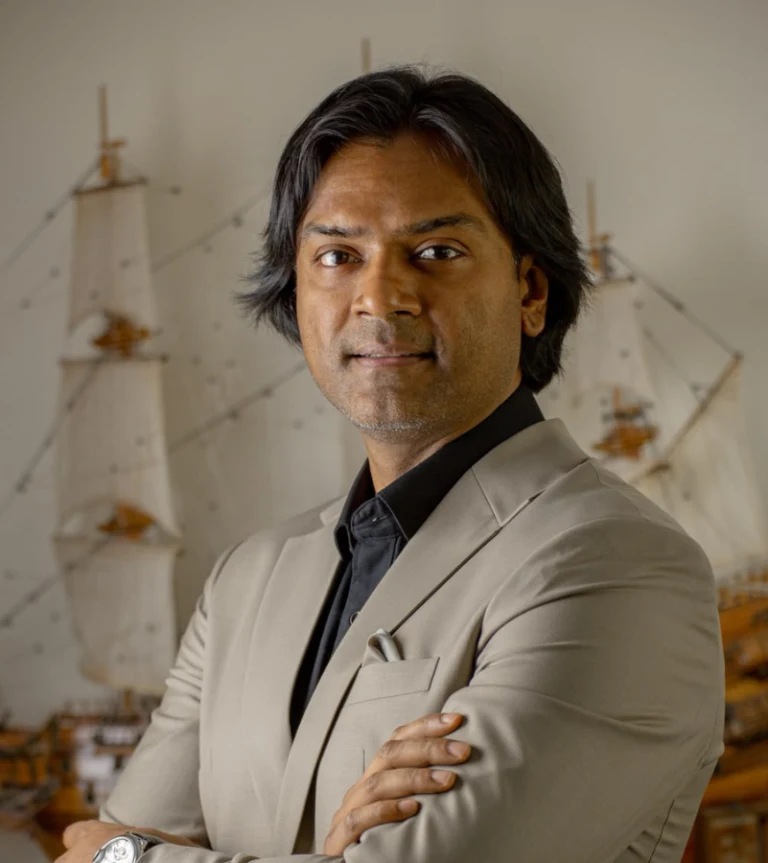
Most investment firms describe what they do in terms of portfolios, mandates or assets under management. Mohhamed Moinuddinn, CEO and Founder of Vyne Global Fortunes Investment, describes it more simply: there is no shortage of money in the world, only a shortage of routes that connect it to the right projects. It's a framing that owes as much to his years in an airline cockpit as it does to any finance textbook.
| Detail | Information |
|---|---|
| Role | CEO and Founder, Vyne Global Fortunes Investment |
| Headquarters | Dubai, UAE |
| Background | Commercial airline captain; real estate; finance |
| What Vyne Global does | Connects family offices, sovereign funds, capital companies and banks to real estate, infrastructure, ESG and logistics projects |
| Current expansion | Launching an in-house capital company to fund projects directly |
What flying taught him about decisions
Before he was structuring capital deals, Moinuddinn was in the cockpit making decisions with far less room for error. "Aviation is a fast-paced environment where you have to make quick decisions, decisions that can be life-saving, that carry real financial cost to the company, and that affect the passengers involved," he says. That responsibility, he explains, extended beyond the flight itself — to the economics of the operation and the people depending on it.
That taught me to be resilient and fast in my thinking, to take calculated risks that minimise problems, and, most importantly, to stay calm. Staying calm is what lets everything run more smoothly.
It's a discipline he carried directly into building an investment network: fast judgement paired with a deliberately steady hand — useful qualities when the decisions on the table involve moving capital across borders rather than aircraft.
Aviation, real estate, finance — and the question that connected them
Moinuddinn's career has run across three industries that don't obviously overlap. Aviation, he says, was a passion — flying, travelling, meeting new people. Real estate came from his family, who taught him about property early on. Finance was different: a pull toward the thing that ultimately underlies almost every transaction. "Everything, ultimately, is related to money," he says. "You buy lunch with money, you pay school fees with money, you buy property with money. So the question became: what makes money move?"
Just like flying a plane from one country to another, I wanted to be the person who can move money from one country to another in a proper, structured way, one that helps build communities. There's no shortage of funding in the world; the money exists. We just need to source it and direct it to where it needs to go to build something real.
A network, not a lender
Despite the name, Moinuddinn is quick to clarify what Vyne Global is not. "Vyne Global is a network, not a wine company, despite the name," he says. The firm works with family offices, sovereign funds, capital companies and banks, positioning itself as the connective layer between capital ("A") and projects ("B"). The next phase of that model is a shift from intermediary to funder: Vyne Global is opening its own capital company, which will let the firm allocate its own funds directly into real estate, infrastructure, real assets, ESG projects and logistics, rather than routing every deal through third-party capital.
Dubai as the connection point
Vyne Global's Dubai headquarters is central to how Moinuddinn describes the firm's reach into the MENA region and beyond. Dubai, he says, is home first — a place where he feels safe — but it is also a platform: access to a network built over decades, and to a business culture that rewards pursuing an idea rather than sitting on it. "Dubai has opened up the whole world for us," he says. "It doesn't limit who you can work with; Dubai works with everyone, connecting the far reaches of the world, from the United States to Antarctica to Australia. Being based here means we're connected to the world."
The decision COVID forced
Moinuddinn points to the COVID-19 period as the moment that reshaped his career. Watching the aviation and travel industries come to a standstill made a certain reality unavoidable: working for someone else means, in a real sense, building someone else's plan rather than your own. "When you're building something of your own, you're in a position to take charge of your own life and support the people around you instead," he says.
He still flies — part time now, no longer as an employee of an airline — while running Vyne Global full time. He describes the team he built through that period with some pride: everyone who has worked with him kept their job and salary through the pandemic, an outcome he attributes to operating "like a team passing the ball toward the same goal."
Leadership without the hierarchy
Ask Moinuddinn whether being both a former airline captain and a business founder comes with assumptions, and he pushes back on the framing. People often assume a captain is automatically "the boss," he says, but that isn't how he sees his role at Vyne Global. "I consider myself a leader because I take responsibility, not because I sit above anyone," he says. "I wear the bigger hat, but everyone carries their own responsibility too." He points to a colleague currently taking on a new phase of his own business, with Moinuddinn funding it while the colleague runs it — an arrangement he holds up as closer to how he wants Vyne Global to operate: shared responsibility, shared upside.
What comes next for Vyne Global
Asked what he wants for the company over the next few years, Moinuddinn doesn't reach for a growth target. "What we want most is global recognition, for people to know Vyne Global, understand what we do, and appreciate how we do it," he says — a goal he frames as belonging to everyone at the firm, not just its founder. The name itself is meant as a statement of intent. "We're not local, we're global," he says.
Sources and editorial references
This profile draws on an interview with Mohhamed Moinuddinn originally published by The Executive Insight. Quotes have been used with attribution; all claims reflect the subject's own account in that interview.