
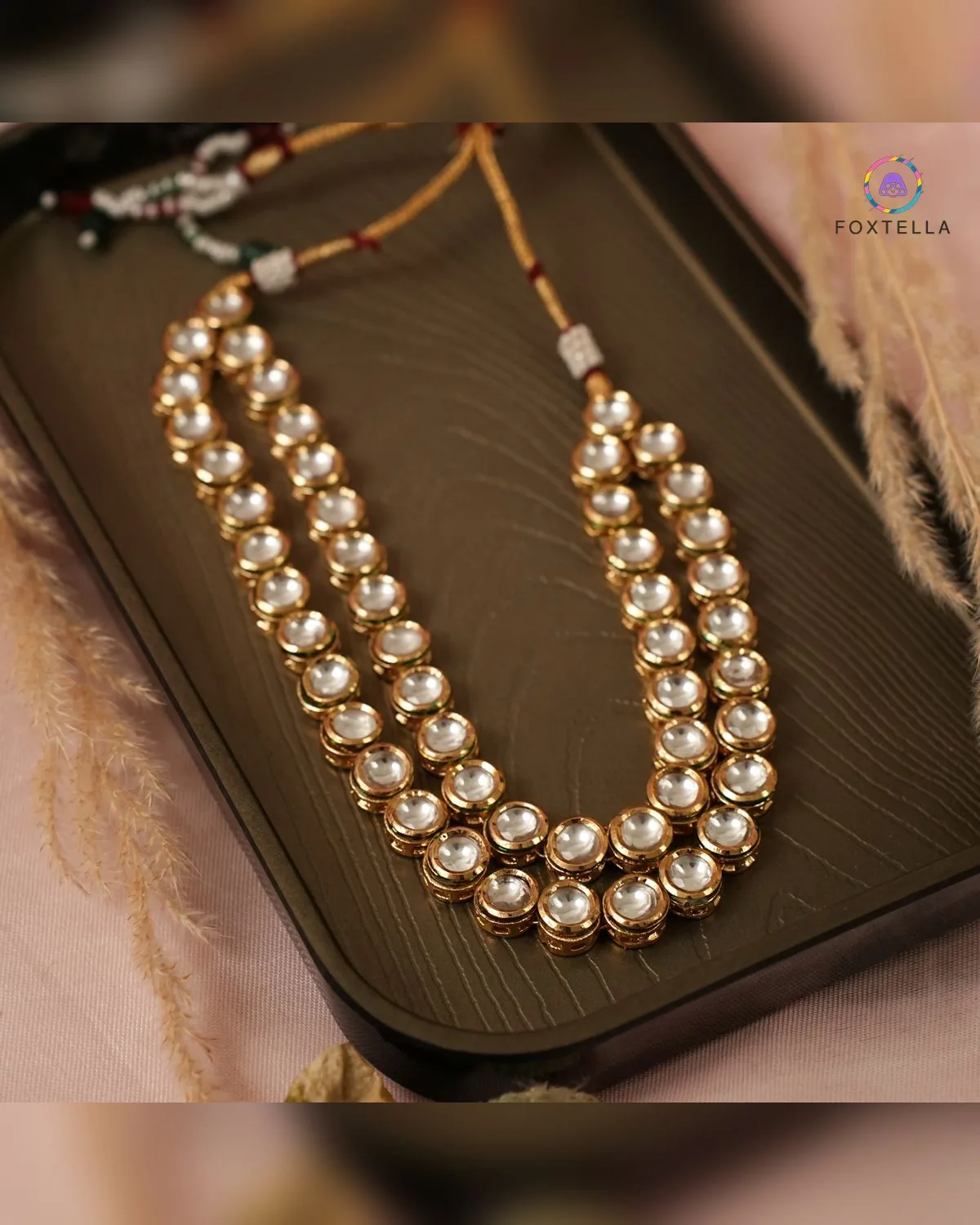
In most Indian homes there is a locker, and in the locker there is gold that comes out four times a year. A wedding, a festival, a milestone birthday. Then back it goes. What a woman actually wears the rest of the year, to an office or a friend's mehendi, has to come from somewhere else and cost a great deal less. That somewhere is one of the least documented consumer markets in the country, and it is where a Lucknow label called Foxtella has spent the past six years.
Foxtella dates its founding to 2020 and names Monika Singh as its founder. The stated ambition was specific: a fashion jewellery brand run by women, making in India, in a category where most of what sits in a shop drawer arrives unbranded from a wholesale market and leaves without a name. Six years later the shopfront is a catalogue of 223 pieces across twelve categories. The cheapest is ₹380. The dearest is a little over ₹9,000. The median is ₹1,070, and that single figure explains the business better than any mission statement.
| Detail | Information |
|---|---|
| Founded | 2020, by Monika Singh |
| Base | Lucknow, Uttar Pradesh |
| Category | Fashion and occasion jewellery |
| Catalogue | 223 products across 12 categories; 124 in stock when read |
| Price band | ₹380 – ₹9,125 · median ₹1,070 |
| Positioning | All-women organisation; 'For Women, By Women'; Make in India |
| Dispatch | 24–48 hours; delivery in 5–7 business days; free shipping |
| Channels | foxtella.in, marketplaces, retail stockists, own outlets |
Figures above were read directly from the brand's live catalogue in July 2026. Stock counts and prices in this segment move weekly.
Starting in the year nobody could hold a wedding
2020 was an unkind year to launch anything that depends on people gathering. Indian jewellery below the bullion tier is almost entirely an occasion business. You buy a set because there is a function to attend, and for long stretches of that year there were no functions. Shops shut. Wedding guest lists collapsed to a legal minimum. The wholesale corridors that supply small labels went quiet.
Foxtella's own site went up the following year and has been rebuilt since; the About page in its current form dates to 2021 and was last revised in mid-2025. Between those two markers sits the part of a small brand's life that never gets written down: the first supplier who takes a chance on a tiny order, the photographs shot on a borrowed table, the months of learning that a listing without a good image simply does not sell.
'For Women, By Women' is a structure, not a campaign
Plenty of consumer brands aim a women's-day post at the calendar once a year. Foxtella makes a structural claim instead: that design, production, marketing and customer service are all staffed by women. Its About page puts it plainly: an all-women organisation, built on the belief that women empower women, selling to the customer it also employs.
It is worth being honest about what an outside publication can and cannot check. We can read the claim; we cannot audit a payroll. What is verifiable is that the brand has organised its public face around it, down to a careers page advertising the same three roles twice, creative designer and product marketing and customer help, once for people who want to work online and once for people who want to work in a showroom. That second column matters more than it looks. In a city like Lucknow, a shopfront job with fixed hours is often the difference between a woman working and not working at all. The pattern shows up across women-led businesses in India, where the constraint is rarely ambition and almost always logistics.
The catalogue is the strategy
Read a small brand's product list closely enough and it tells you what the founders believe. Foxtella's 223 pieces are weighted heavily toward one thing: 55 of them are necklace-and-earring sets, more than twice any other category. Then 31 rakhis, 30 bracelets, 23 pendants, 17 rings, 15 maang tikka, 11 mangalsutra, 10 each of bangles, earrings and necklaces, six earring-and-tikka sets, and five nath.
- Sets over singles: the buyer is dressing for an event, not topping up a wardrobe.
- Mangalsutra, nath, maang tikka and tikka sets together outnumber plain earrings and necklaces, so this is a bridal-adjacent catalogue.
- 159 of 223 pieces sit at ₹1,500 or below, roughly seven in ten.
- 124 pieces were in stock when we read the site; the rest were listed but unavailable.
That price distribution is a deliberate ceiling, not an accident. Above roughly ₹2,000 a shopper in this market starts weighing fashion jewellery against a small gold purchase, and fashion jewellery loses. Below ₹1,500 the comparison never happens. Foxtella has parked most of its range where the question does not get asked.
Below ₹1,500 nobody compares your necklace to gold. Most of the catalogue lives there, and that is not luck.
From '102172-RGNBTQ BR' to 'Kundan Mahal'
The most interesting thing in the catalogue is a naming convention changing mid-stream. Older listings carry warehouse codes, strings like 102172-RGNBTQ BR, the kind of label that exists for a stockroom and nobody else. Among the hundred most recently added products, 81 have actual names and only 19 still carry codes.
And the names are doing work. Kundan Mahal. Thanjavur Treasure. Shreehaar. Nidhivan. Ram Darbaar. Set beside those sit Serpentia, Blush Galaxy, Linea, Mystic Coil. It is one catalogue reaching for a customer who wants heritage and one who wants something she could wear to a bar, without asking either to shop elsewhere. Naming a product is the cheapest branding there is, and the hardest to sustain across two hundred of them. Somewhere between the codes and the names, a supplier decided to become a brand.
The festival calendar as a product roadmap
The newest additions to the site are 31 silver rakhis, and their titles read like a shortlist of what an Indian brother might actually want on his wrist: Ganpati, Om, Shiva, Kanha, Swastik, Veera, Shri, and one filed simply as Bro. A rakhi sells in a two-week window and is worthless in the fifteenth. Building an entire seasonal line for that window is a bet placed months earlier on tooling, stock and photography.
This is how the business breathes. Rakhi in summer, wedding sets from late autumn, mangalsutra and nath running underneath all year. It also concentrates risk in a way a monthly-subscription business never faces: miss the shipping deadline before a festival and the inventory does not sell late, it sells next year. Every small Indian consumer brand learns this once, expensively.
The unglamorous half: 48 hours, seven days, ₹50 for cash
Foxtella's published promise is dispatch within 24 to 48 hours and delivery in five to seven business days, with a tracking ID by email or SMS, free shipping, and ₹50 added for cash on delivery. Cards, UPI, net banking and COD are all accepted. None of that is remarkable, which is the point. In a category where a customer's last unbranded purchase arrived whenever it arrived, a stated timeline is itself a differentiator.
The brand also says it sells through Amazon, Flipkart, Myntra and Tata Cliq, alongside retail stockists and its own outlets. We could not independently confirm the marketplace listings, and readers should treat the channel claim as the company's own. What the site does show plainly is the operational strain underneath: 99 of 223 listings sat out of stock. For a label buying in small runs, that is less a failure than an arithmetic. Capital tied up in a slow-moving bangle is capital not available for the necklace set that sells out. Anyone who has watched India's quick-commerce operators fight the same war with vastly more money will recognise the shape of it.
What the next six years have to fix
Three things stand between where Foxtella is and where it says it wants to be. The first is materials. The catalogue signals finish with initials, AD for American diamond, but nowhere states plating thickness, base metal or whether a piece resists tarnish. That silence is standard across the segment and it is exactly what a maturing buyer now asks about first.
The second is the site's own unfinished corners; the FAQ page still carries placeholder text under its four headings. It reads less like carelessness than like a small team spending its hours on stock and dispatch instead of copy, which is the correct order of priorities right up until the day it is not.
The third is the hardest. A catalogue of 223 pieces at a ₹1,070 median can be run by a determined team out of one city. Ten times that cannot, and the founding promise, that the women who make the jewellery are also the women who run the company, gets tested precisely at the point where scaling usually means handing production to whoever quotes lowest. Foxtella's next chapter will be judged on whether the org chart survives the growth. That is the interesting question, and it will not be answered by a festival season.