
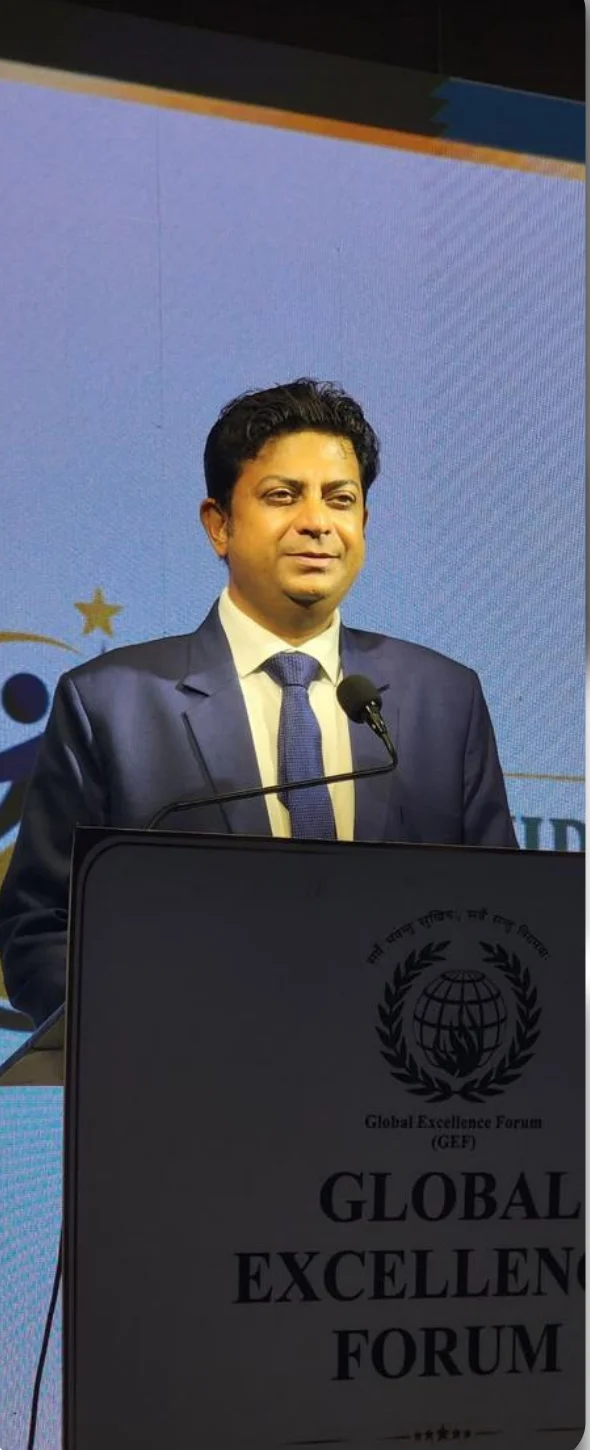
In an era when success is often measured by titles, businesses and awards, Dr. Sameen Hasan represents a different understanding of achievement — one rooted in service, compassion and responsibility. An entrepreneur, social reformer, philanthropist and community development advocate from Patna, Bihar, Dr. Hasan has built his journey around a simple but powerful belief: true success becomes meaningful when it creates opportunities and hope for others.
True success becomes meaningful when it creates opportunities and hope for others.
The women who shaped his vision
Three generations of women hold a special place in Dr. Hasan's understanding of strength and service. Among his earliest inspirations was his great-grandmother, Mrs. Najma Shad, a distinguished Urdu writer whose work — including Akhri Chawanni — was also broadcast by Akashvani Patna. Beyond her literary voice, he remembers her as a woman who understood the importance of nurturing children, teaching etiquette and developing strong moral values.
His grandmother, Mrs. Ishrati Ibrahim, taught him a philosophy that continues to influence his life: when the intention to create a better future is strong and commitment to the goal is unwavering, obstacles cannot ultimately define one's destiny. His mother, Mrs. Shahnaz Shamim, a retired school principal in Patna, and his father, Mr. Shamimul Hasan, a retired EPFO officer, raised him in an environment where education, discipline and public service were deeply respected.
A life partner behind the journey
Every public journey has a private support system, and for Dr. Hasan, one of its strongest pillars is his wife, Mrs. Kainat Hasan — an MBA graduate who previously worked with UltraTech Cement in finance and logistics. He describes her as his soulmate and the backbone of his journey, whose encouragement has given him the confidence to pursue ambitious goals while remaining connected to his larger purpose.
Turning values into social action
Today, Dr. Hasan's professional life extends across entrepreneurship, entertainment, education and community development. He is Founder & Chairman of Eksathi Foundation, Managing Director of SevenTunez Entertainment and SHF Enterprises, and a business partner at R.M. Group of Companies. Through Eksathi Foundation, his social initiatives focus particularly on underserved communities, women and girls — spanning women's empowerment, education, menstrual hygiene awareness, sanitation, healthcare awareness and humanitarian assistance including food and winter-blanket distribution. His COVID-19 humanitarian efforts were recognised by the Rural Development Authority of Odisha.
It is about restoring hope.
Recognition is a milestone, not the destination
Dr. Hasan's journey has been accompanied by recognitions including the Indian Icon Award 2024, Bharat Samman 2025, and recognition at the National Leadership Conclave 2026. Yet he maintains that awards are not the ultimate measure of success — the deeper measure, in his view, is the difference one makes in the lives of others. As he continues to build his entrepreneurial ventures and expand his social initiatives, his journey offers a reminder that professional ambition and humanitarian responsibility do not have to exist separately. They can strengthen one another.
Grassroots philanthropy in India's smaller cities
Dr. Hasan's work sits inside a broader shift in how social impact gets built in India outside the metros. Patna and the wider Bihar region have historically drawn less structured CSR and NGO investment per capita than Delhi, Mumbai or Bengaluru, which has pushed much of the responsibility for local welfare work onto individual entrepreneurs and family foundations rather than large institutional players. Menstrual hygiene access in particular remains an area where national programmes exist on paper but implementation gaps persist at the district level — surveys by public health researchers have repeatedly found that awareness and product access diverge sharply between urban and rural Bihar, which is precisely the gap that community-level initiatives like Eksathi Foundation's sanitation and hygiene programmes are designed to narrow.
What distinguishes entrepreneur-led philanthropy of this kind from purely corporate CSR is proximity: founders who also run local businesses tend to have direct, repeated contact with the communities they serve, which shapes programme design around what people actually need rather than what looks good in an annual report. That model — business income funding hands-on local welfare work, rather than outsourcing it to a separate charitable arm — is becoming more visible across India's tier-2 cities as a new generation of founders builds parallel tracks in enterprise and social service.
Sources and editorial references
This profile is adapted from Dr. Sameen Hasan's featured profile in the September 2026 print edition of Global Cover Story, based on a self-submitted account and photographs. Career history, dates and figures reflect the subject's own account and have not been independently verified against public records.