
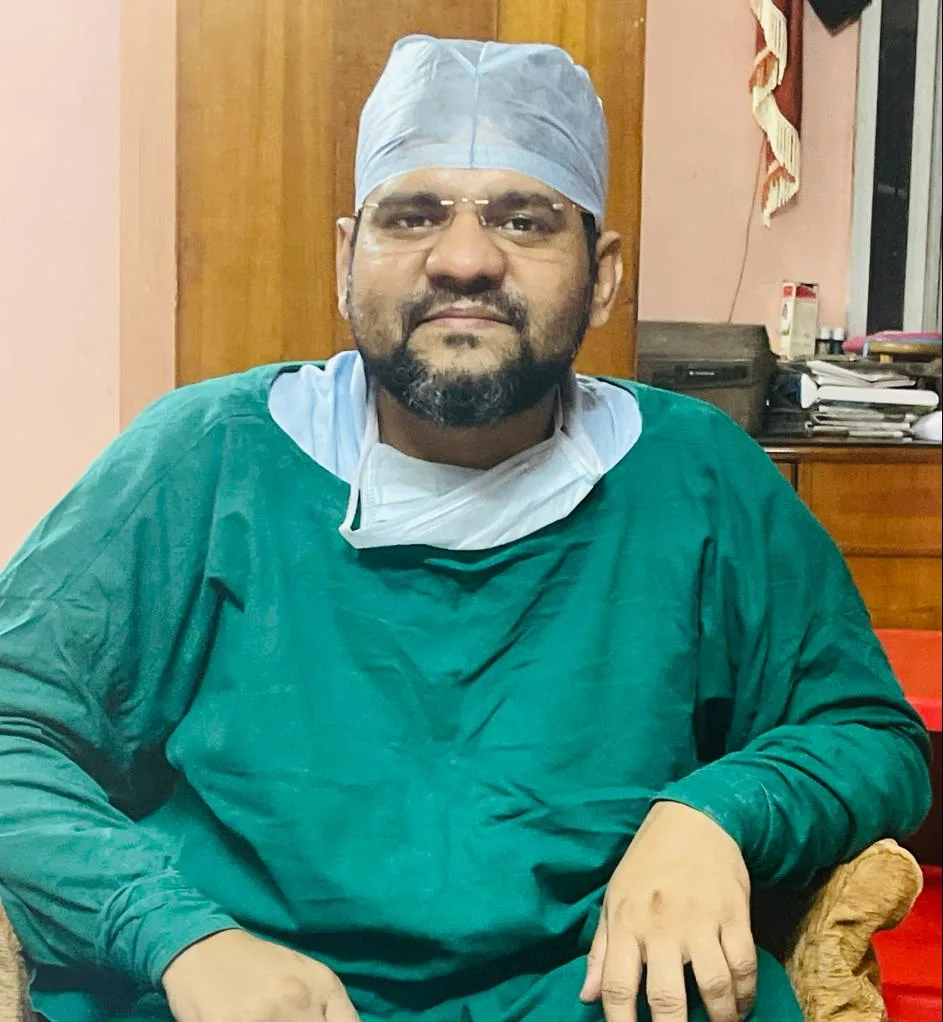
Medicine is often described as a profession of knowledge and skill. For the doctors who stay in it longest, it is just as much a profession of patience, responsibility and service. Dr. Asif Hossain's career reflects all of these. A General Surgeon, Assistant Professor and Visiting Surgeon in Kolkata, he has spent the past fifteen years moving between the operating theatre, the outpatient clinic, the classroom and the community.
| Detail | Information |
|---|---|
| Specialty | General Surgery, with fellowships in minimal access surgery |
| Roles | General Surgeon · Assistant Professor · Visiting Surgeon |
| Based in | Kolkata, West Bengal |
| Qualifications | MBBS (2006) · MS, General Surgery (2011) · FMAS (2015) · FIAGES (2017) |
| In practice since | 11 July 2011 |
| Other work | Medical camps, community healthcare and teaching |
The beginning of a meaningful journey
Like every surgeon, Dr. Hossain's path began with years of study. He completed his MBBS in 2006 and then specialised, finishing his MS in General Surgery in 2011. Surgical training is among the most demanding in medicine: it combines clinical judgement with manual precision, and asks young doctors to take responsibility for patients at their most vulnerable.
On 11 July 2011, the same year he completed his MS, he began his first OPD at Parharpur Nursing Home in Kolkata. For a young surgeon, that first outpatient clinic is where training meets real life: diagnosing, explaining options to patients and families, and building the trust that every operation depends on.
| Year | Milestone |
|---|---|
| 2006 | Completes MBBS |
| 2011 | Completes MS in General Surgery |
| 11 July 2011 | Begins his first OPD at Parharpur Nursing Home, Kolkata |
| 2015 | Earns the Fellowship in Minimal Access Surgery (FMAS) |
| 2017 | Earns the FIAGES fellowship in gastrointestinal endo-surgery |
Growing through experience and surgical learning
Surgery has changed dramatically over the past two decades, and much of that change has come from minimal access, or laparoscopic, techniques. Instead of a single large incision, the surgeon works through a few small ones, using a camera and long, slender instruments. For suitable patients, keyhole approaches are generally associated with smaller scars, less pain after the operation and a faster return to normal activity, though the right approach always depends on the individual case.
Dr. Hossain invested in these skills after qualifying. In 2015 he completed the Fellowship in Minimal Access Surgery (FMAS), a credential awarded by the Association of Minimal Access Surgeons of India after hands-on training and an examination in laparoscopic surgery. In 2017 he added the fellowship associated with the Indian Association of Gastrointestinal Endo Surgeons (FIAGES), which focuses on laparoscopic and endoscopic surgery of the digestive system.
Together, the two fellowships reflect a commitment many senior surgeons share: a qualification is the start of surgical learning, not the end of it. Techniques, equipment and evidence keep moving, and good surgeons keep moving with them.
Beyond the operating room
For Dr. Hossain, healthcare does not stop at the hospital door. He has been involved in medical camps, community healthcare initiatives and patient-support activities, which bring consultations and health awareness to people who might otherwise struggle to reach a specialist.
Work of this kind matters in India, where many surgical conditions are seen late because patients delay seeking care, whether because of cost, distance or uncertainty about where to go. A camp that identifies a hernia, a gallbladder problem or a suspicious lump early can change the outcome entirely.
Sharing knowledge with future medical professionals
Alongside his clinical practice, Dr. Hossain serves as an Assistant Professor, contributing to the training of medical students and young doctors. Teaching surgery means passing on more than technique. It means modelling how to examine a patient carefully, how to make decisions under pressure, how to communicate difficult news and how to keep learning throughout a career.
He also works as a Visiting Surgeon, which allows him to bring his experience to patients beyond a single institution.
A profession that demands lifelong learning
Looking across his career, a clear pattern emerges: medical school, then surgical training, then practice, then advanced fellowships, then teaching. Each stage built on the one before. It is the pattern of a doctor who treats continuing education as part of the job, which in surgery it has to be.
This article profiles Dr. Hossain's professional journey and is not medical advice. Anyone with a health concern should consult a qualified doctor who can assess their individual situation.
A journey rooted in humanity
From his first OPD in Kolkata to his work as a fellowship-trained surgeon and teacher, Dr. Asif Hossain's journey brings together surgical knowledge, patient care, continuing education and responsibility to the community. Above all, it is a reminder that the best measure of a doctor is not the qualifications on the wall but the difference made to patients' lives.
For more stories of doctors and health professionals working beyond the clinic, read our profiles of Dr. Charu Dutt Arora and Dr. Partha Narayan Joardar, or explore the Healthcare desk.