
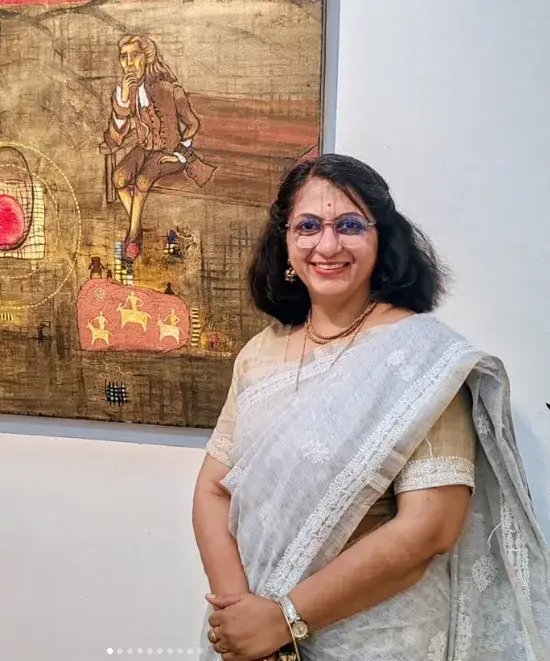
Riddhima Sarraf has spent more than two decades building a body of work that sits at a deliberate intersection — where Indian aesthetic traditions meet the language of contemporary art, where academic research informs visual practice, and where painting, sculpture and mixed media serve not as separate disciplines but as different registers of the same inquiry.
Based in New Delhi and working from the Lalit Kala Garhi Studios — the artist studio complex run by India's national academy of fine arts — Sarraf has exhibited at some of the country's most significant art institutions and built a presence that extends from Mumbai's Jehangir Art Gallery to galleries in London, Italy, Chicago and the Middle East. Hers is a career built on consistency rather than spectacle, on depth rather than trend.
From Hathras to the Garhi Studios
Sarraf's journey in art began in Hathras, Uttar Pradesh, where she started creating at the age of six — inspired, by her own account, by watching her father sketch. That early impulse would eventually lead to formal training: a Master of Arts in Drawing and Painting, a separate MA in English, and specialised study in Tanjore Art under Jitendra Sarswat and Contemporary Art under Sanjay Roy at Triveni Kala Sangam in Delhi.
The dual grounding — traditional Indian art forms alongside contemporary practice, visual art alongside the literary disciplines of an English MA — gives Sarraf's work a textual quality that distinguishes it from artists who operate purely within the visual. She thinks in references: the Bhakti Movement, Ajanta's pictorial traditions, the philosophical frameworks of the Gita. These are not decorative allusions but structural elements of how she approaches a canvas.
The Exhibition Record
Over twenty years of practice, Sarraf has built an exhibition record that spans institutions and geographies. In India, she has shown at Jehangir Art Gallery in Mumbai, the National Gallery of Modern Art in Delhi and Sahitya Kala Parishad — venues that represent the established institutional circuit of Indian contemporary art.
Internationally, her work has been exhibited at Spazio-Tempo Arte in Italy, Greek Street Gallery in London, Arterie Fine Art Gallery in Chicago, and at venues in France, Dubai and Abu Dhabi. Her paintings are held in private collections across Florida, Italy, Dubai, Chennai, Mumbai and Delhi — a geographic spread that reflects both the portability of her themes and the growing international appetite for Indian contemporary art.
Her paintings, primarily in acrylic and oil on canvas, are listed on platforms including Saatchi Art and ArtZolo, with works priced between INR 50,000 and INR 1,70,000. The range signals a mid-career artist whose market is established but still building — accessible enough to attract collectors, serious enough to hold institutional interest.
Recognition and the Ministry Fellowship
Among Sarraf's most significant recognitions is a Junior Fellowship from the Ministry of Culture, Government of India — one of the country's most competitive awards for practising artists, designed to support sustained creative work over a fellowship period. The fellowship places her in a lineage of artists whose work has been formally recognised by India's national cultural infrastructure.
She has also received the Kalaa Sanskriti Award by Agnipath and the Camlin Art Camp Award in Varanasi — the latter recognised by Greek Street Gallery in London. She has participated in national art camps including a Lalit Kala camp commemorating 150 years of Mahatma Gandhi and the Beti Bachao art camp, reflecting a practice that engages with public and social themes as readily as gallery contexts.
The Writer and Researcher
Sarraf is not only a visual artist — she is also a published author and academic researcher. Her Hindi poetry collection 'Kirdaar' is available on Amazon India, and she has written several other books including 'Knollina Night', 'Gita Nityapath', 'Mokshagita' and 'Kala Sampoorna Yatra'. The titles themselves reveal the philosophical and spiritual currents that run through her visual work.
On the research side, she has published an academic paper — 'Confluence of Traditional and Contemporary Art of India, Need, Importance' — in the International Journal of Innovative Research in Science, Engineering and Technology (IJIRSET) in June 2022. The paper examines the relationship between India's traditional art heritage and its contemporary visual culture — the same question her studio practice explores through form and material rather than citation.
This dual output — visual art and written scholarship — is unusual in the Indian art world, where the studio and the library tend to operate as separate institutions. For Sarraf, they are two sides of the same practice: the research informs the art, and the art tests the research.
ArtistTech and the Studio Practice
Beyond her personal practice, Sarraf is the founder of ArtistTech, a platform that handles art commissions, sculptures, murals, wall art and portraits. The venture positions her as both a practising artist and a facilitator of art — connecting collectors and institutions with visual work while maintaining her own studio output from the Garhi complex.
Her artistic style has evolved over two decades — from realistic and surreal registers to increasingly abstract work that she describes as adventures with colours, shapes and patterns. The evolution is visible across the body of work listed on gallery platforms: earlier pieces carry recognisable figurative elements, while more recent canvases lean into abstraction, layered surfaces and the expressive potential of pure colour.
The Road Ahead
Twenty years in, Sarraf's practice shows no signs of narrowing. The combination of institutional exhibition history, a Ministry of Culture fellowship, academic publication, multiple books and an active commercial practice through ArtistTech makes hers one of the more quietly comprehensive careers in Indian contemporary art today.
The art world tends to reward either market success or institutional validation — rarely both at once, and almost never alongside academic research and literary output. Sarraf has managed to maintain all four tracks simultaneously, which suggests a career driven less by strategic positioning than by genuine intellectual curiosity about what art can do, what it can say, and where Indian visual culture sits in the larger conversation.
Art, as she has put it, is the warmth that sprouts and blossoms the seed of life. For Sarraf, that warmth is not a metaphor — it is the daily practice of showing up at the studio, picking up a brush and continuing a conversation that started in Hathras at the age of six.
Sources and editorial references
This profile draws on independently verified public sources. Claims have been cross-referenced where possible.
- Saatchi Art — Riddhima Sarraf artist profile: saatchiart.com
- ArtZolo — Riddhima Sarraf paintings collection: artzolo.com
- Amazon India — Kirdaar by Riddhima Sarraf: amazon.in
- IJIRSET — Confluence of Traditional and Contemporary Art of India (June 2022): ijirset.com
- Instagram — @riddhima_art: instagram.com/riddhima_art
- Global Cover Story feature — Riddhima Sarraf (LinkedIn, August 2026)