
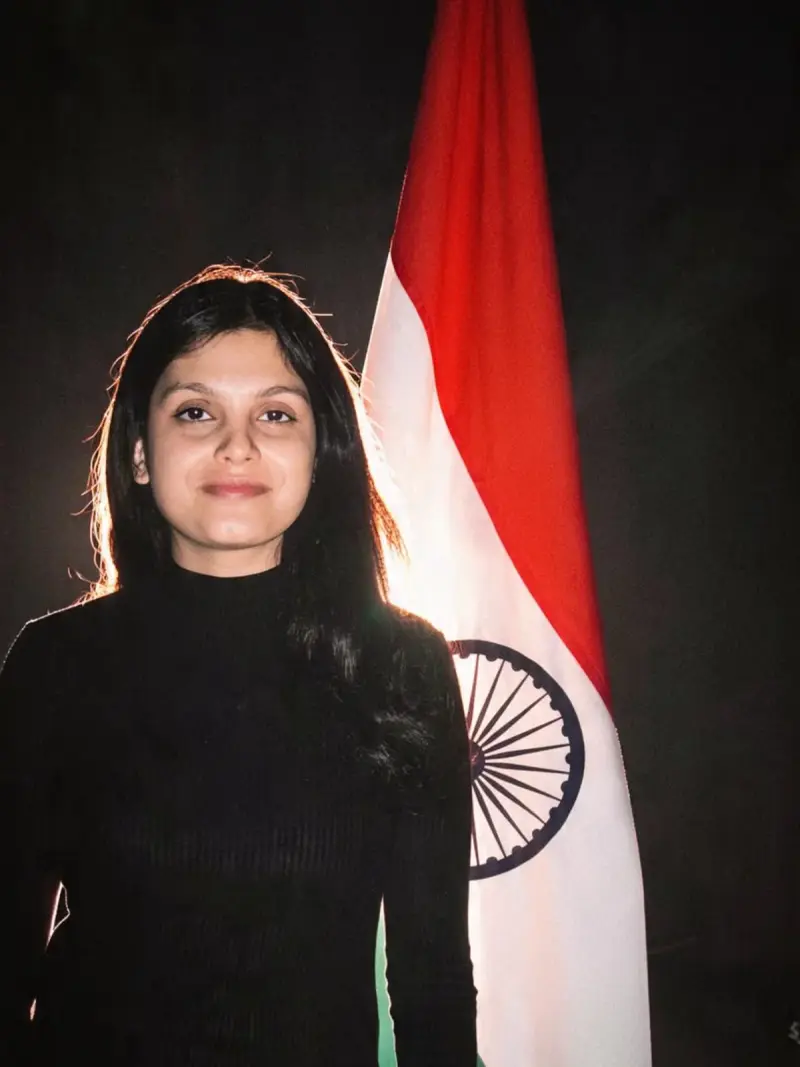
Radha Hardas has spent most of her life inside India's sporting ecosystem. She began young, became a national athlete across multiple disciplines, and learned discipline, ambition and resilience through competition. But what sets her apart is what she did next: she took the lessons of the court and the strategy boardroom and channelled them into building the systems she wished had existed when she was the one competing.
Today, at an age when many are still finding their footing, Hardas operates across three distinct worlds — sport, technology and agriculture — with a coherence that makes sense only when you trace the thread back to the beginning. Each venture is an expression of the same idea: that performance without purpose is incomplete, and that the most meaningful work happens when you build for others what no one built for you.
| Detail | Information |
|---|---|
| Based in | Mumbai, Maharashtra, India |
| Education | BA Economics, St. Xavier's College, Mumbai (2020–2023) |
| Sports | National-level basketball (silver medallist, ICSE Nationals 2015); FIBA Players First scholarship, Barcelona 2016; sabre fencing |
| Career | Red Bull India → Accenture Strategy → Founder, Jigar (sports tech) → Co-founder & CEO, Murambi Farms |
| Recognition | Honoured by CEO India Weekly as one of the 100 Most Powerful Women in India |
| Ventures | Jigar — sports-tech platform for athlete development; Murambi Farms — organic agro-tourism near Nashik |
Forged on the court
Sport entered Radha Hardas's life early and never left. Growing up, she competed in basketball with the intensity of someone who understood that the scoreboard was not the point — the discipline was. By 2015, she had reached the national stage, winning a silver medal at the ICSE School Basketball Nationals in Ahmedabad. A year later, her talent earned her a FIBA Players First scholarship at the North Atlantic Basketball Academy in Barcelona — an opportunity that placed her among some of the best young basketball talent in the world.
The Barcelona experience was formative in ways that went beyond the sport. It showed her what structured athlete development looked like: the coaching infrastructure, the data, the support systems that turned raw talent into consistent performance. It also showed her, by contrast, what Indian athletes typically lacked. That gap between what was possible and what was available at home would become the central problem of her professional life.
Alongside basketball, Hardas trained in sabre fencing — an unusual combination that speaks to a competitive restlessness, an unwillingness to be defined by a single discipline. The fencer's instinct for timing, distance and decisive action would prove useful far beyond the piste.
The academic and corporate foundation
Hardas chose to study Economics at St. Xavier's College, Mumbai — one of the country's most competitive undergraduate programmes. The choice was deliberate. Economics gave her a framework for understanding systems, incentives and markets — the vocabulary she would later need to articulate why Indian sport underperformed relative to its talent pool and what structural changes could fix it.
Her first corporate role was at Red Bull India, where she worked on strategic marketing initiatives. Red Bull's global brand is inseparable from sport and extreme performance, and the role gave Hardas a front-row view of how a multinational corporation builds communities around athletic achievement. She learned how storytelling, sponsorship and brand positioning could amplify athletes in ways the traditional Indian sporting establishment rarely managed.
From Red Bull, she moved to Accenture Strategy — a significant shift from the energy of sports marketing to the rigour of management consulting. At Accenture, she worked on strategy engagements advising leaders across markets, learning how to diagnose organisational problems, build business cases and think in systems. It was demanding, analytical work — and it gave her the toolkit she would later use to build her own ventures.
I want every athlete who dreams with the Tiranga in their mind to have better systems, better access, and a fairer chance.— Radha Hardas
Building Jigar: the sports-tech mission
The founding of Jigar was not a pivot from corporate life but a return to first principles. Hardas had seen Indian sport from every angle — as a competing athlete, as a marketing professional at Red Bull, as a strategy consultant at Accenture. What she kept coming back to was the same structural gap she had first noticed in Barcelona: Indian athletes had talent, but the ecosystem around them was fragmented, opaque and unevenly distributed.
Jigar is a sports-technology platform designed to address that gap. Its mission is to improve the flow of information, access and opportunities for athletes across India — connecting talent with infrastructure, making pathways visible that were previously hidden behind institutional gatekeeping, and using technology to democratise what had historically been a privilege of geography and connections.
The problem Jigar tackles is real and well-documented. India's sporting infrastructure has long been characterised by a paradox: a vast population of young, athletic people and a persistent underperformance at the international level relative to that population. The reasons are systemic — poor coaching pipelines, limited access to facilities outside major cities, a lack of transparent selection processes, and minimal career support for athletes who do not make it to the very top. Jigar aims to chip away at each of these barriers, one data point and one connection at a time.
Murambi Farms: roots in the soil
If Jigar represents the technology side of Hardas's ambitions, Murambi Farms represents something older and more grounded. Located near Nashik in Maharashtra — a region known for its vineyards, temples and fertile soil — Murambi is an organic agro-tourism venture that combines sustainable farming with rural hospitality.
The farm practises 100% organic agriculture with Gir cows and offers visitors a rustic, wall-less countryside experience. It is a working farm, not a resort — guests engage with the rhythms of rural life, from milking to harvesting, in a setting that is deliberately simple. The property sits along the Sanjegaon–Trimbakeshwar road, about five kilometres off the highway, close enough to Nashik to be accessible but far enough to feel genuinely removed from urban life.
For Hardas, Murambi is not a side project. It is an expression of the same values that drive Jigar — a belief that building something meaningful requires getting close to the ground, understanding the people you serve, and creating systems that are sustainable rather than extractive. The farm's commitment to organic practices, gender diversity in its workforce and environmental responsibility reflects an entrepreneurial philosophy that measures success in impact rather than scale alone.
Recognition and advocacy
Hardas's work across sport, technology and agriculture has drawn attention from platforms that track emerging Indian leaders. She was honoured by CEO India Weekly as one of the 100 Most Powerful Women in India — a recognition of the Jigar business model and her broader contribution to the Indian sports ecosystem.
Beyond her ventures, she is a founding member of the Women's Diplomatic Circle Mumbai and the Women's Society for Environment, Culture and Education (WSECE) — organisations that reflect her interest in diplomacy, environmental advocacy and women's empowerment. These are not ceremonial affiliations. They are extensions of a worldview in which leadership is not confined to a single domain but expressed wherever systems can be improved and access can be widened.
If you are capable of dreaming in many directions, do not shrink yourself to fit into one. Build a life big enough for them all.— Radha Hardas
The road ahead
Radha Hardas is building in public and in parallel — a sports-tech platform, an organic farm, a series of advocacy commitments — and she is doing it with the same competitive focus she once brought to the basketball court. The through-line is not restlessness but range: a conviction that the most interesting careers are not linear but layered, and that the best way to change a system is to engage with it from as many angles as possible.
Her story is still early. Jigar has not yet reached the scale that would make it a household name in Indian sport, and Murambi Farms is a young venture finding its rhythm. But the trajectory is clear: from athlete to strategist to founder, Radha Hardas is building the infrastructure she wished had existed — for athletes, for farmers, for the next generation of Indian women who dream in many directions at once.
Sources and further reading
- Global Cover Story feature — Radha Hardas: Where Performance Meets Purpose (Instagram, August 2026)
- LinkedIn — Radha Hardas: Founder | National athlete | Ex-Strategy consultant: linkedin.com
- FIBA 3x3 — Player profile and Players First scholarship, Barcelona 2016: play.fiba3x3.com
- Womenpreneur India — speaker and panellist feature
- Murambi Farms — organic agro-tourism near Nashik, Maharashtra: instagram.com/murambifarms