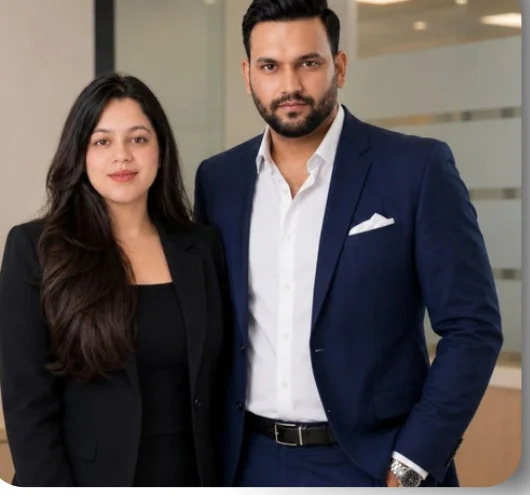
Artificial intelligence is no longer a distant technology reserved for large corporations. It is rapidly becoming part of how businesses market themselves, communicate with customers, manage operations and make decisions. At the centre of this shift in Indore are Arpit K. Goyal and Abhidha Dhariwal, who are shaping Kivashe around the needs of businesses preparing for an AI-driven economy.
Storytelling meets strategy
Arpit brings experience across filmmaking, animation, branding, technology and digital marketing — a background in storytelling and communication that has influenced how Kivashe approaches brand building. Rather than treating marketing as only promotion, the company focuses on understanding how a business presents itself, what it stands for, and how it communicates with the people it wants to reach. As AI becomes more common in content and marketing, Kivashe is exploring how these tools can support stronger research, customer communication, lead management and brand positioning.
Keeping the human side of transformation
Abhidha Dhariwal contributes to this vision by keeping the human side of transformation at the centre. Kivashe believes AI can improve speed and reduce repetitive work, but that creativity, judgement, relationships and strategic thinking still depend on people. This thinking shows in the company's interest in AI agents and intelligent workflows that can support lead qualification, prospect research, follow-ups, appointment scheduling and personalised communication — reducing routine work for small and growing businesses so teams can focus on sales and relationships.
The focus is on using technology where it can genuinely improve the way a business works.
Kivashe is building its future direction around three connected areas: strategic brand positioning, AI-powered marketing and intelligent business automation. For Arpit and Abhidha, the larger opportunity is not simply to help businesses become more digital — it is to help them become more adaptive, efficient and prepared for changing customer expectations, with meaningful progress still depending on clear strategy and human understanding.
AI adoption among India's small and mid-sized businesses
Indore, where Kivashe is based, sits within Madhya Pradesh's fast-growing tier-2 startup corridor, an ecosystem that has expanded well beyond the traditional Bengaluru–Delhi–Mumbai axis as founders increasingly build for national and global clients from lower-cost cities. AI-powered marketing and automation tools have become particularly attractive to small and mid-sized Indian businesses precisely because they lower the cost of capabilities — copywriting, lead research, customer segmentation — that used to require dedicated in-house teams a founder-led SME could rarely afford. Surveys of Indian MSME adoption consistently show marketing and customer communication as among the first functions businesses automate with AI, ahead of more operationally complex uses like supply chain or finance.
Agencies positioning themselves at this intersection of creative branding and AI automation, as Kivashe does, are also responding to a specific gap: many AI marketing tools are built generically for a global market and require local adaptation to Indian buying behaviour, language mix and platform habits (WhatsApp Business remains far more central to Indian SME customer communication than it is in most Western markets, for instance). Founders with backgrounds spanning storytelling and technical execution — as Arpit and Abhidha's combined experience does — are positioned to bridge that adaptation gap rather than simply reselling off-the-shelf AI tooling.
Sources and editorial references
This feature is adapted from Kivashe's featured profile in the September 2026 print edition of Global Cover Story, based on a self-submitted account and photographs. Company details reflect the founders' own account and have not been independently verified.